6 Saltwater Fishing Rigs and How to Pick the Right One
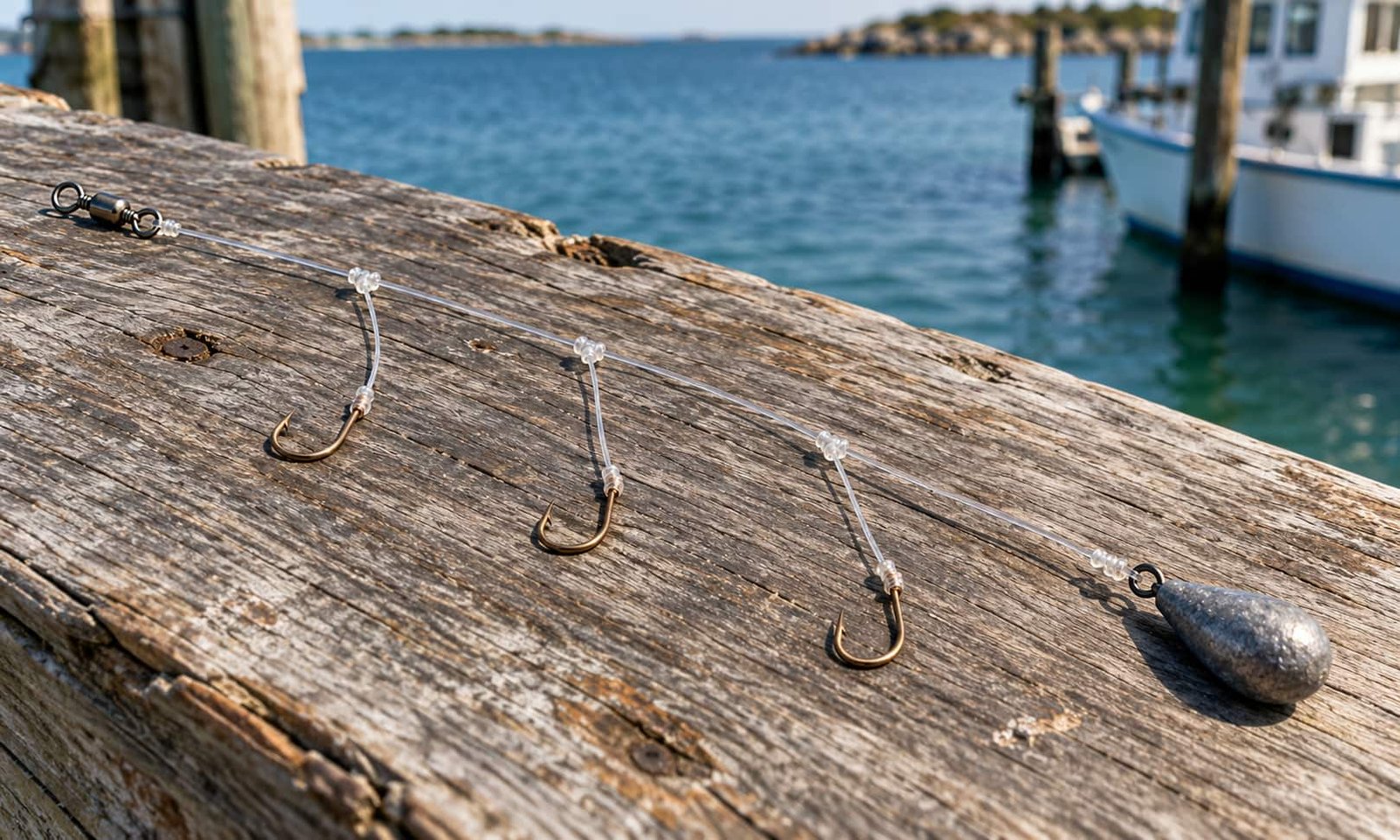
Choose saltwater fishing rigs by where you fish and what you want to catch. A beach session for whiting (US kingfish), a pier session for live bait, and a boat trip for cutlassfish call for different arrangements of line, hooks, and weight.
A fishing rig is the arrangement of terminal tackle at the end of the main line. Terminal tackle includes hooks, leaders, swivels, floats, sinkers, and lures. The main line runs from the reel. A leader is a separate section of line between the main line and the rig, hook, or lure.
The numbered line sizes below use the Japanese sizing system, not pound-test ratings. Hook numbers refer to Japanese hook patterns and do not translate directly into matching US or European sizes.
Which saltwater fishing rigs suit your fishing spot?
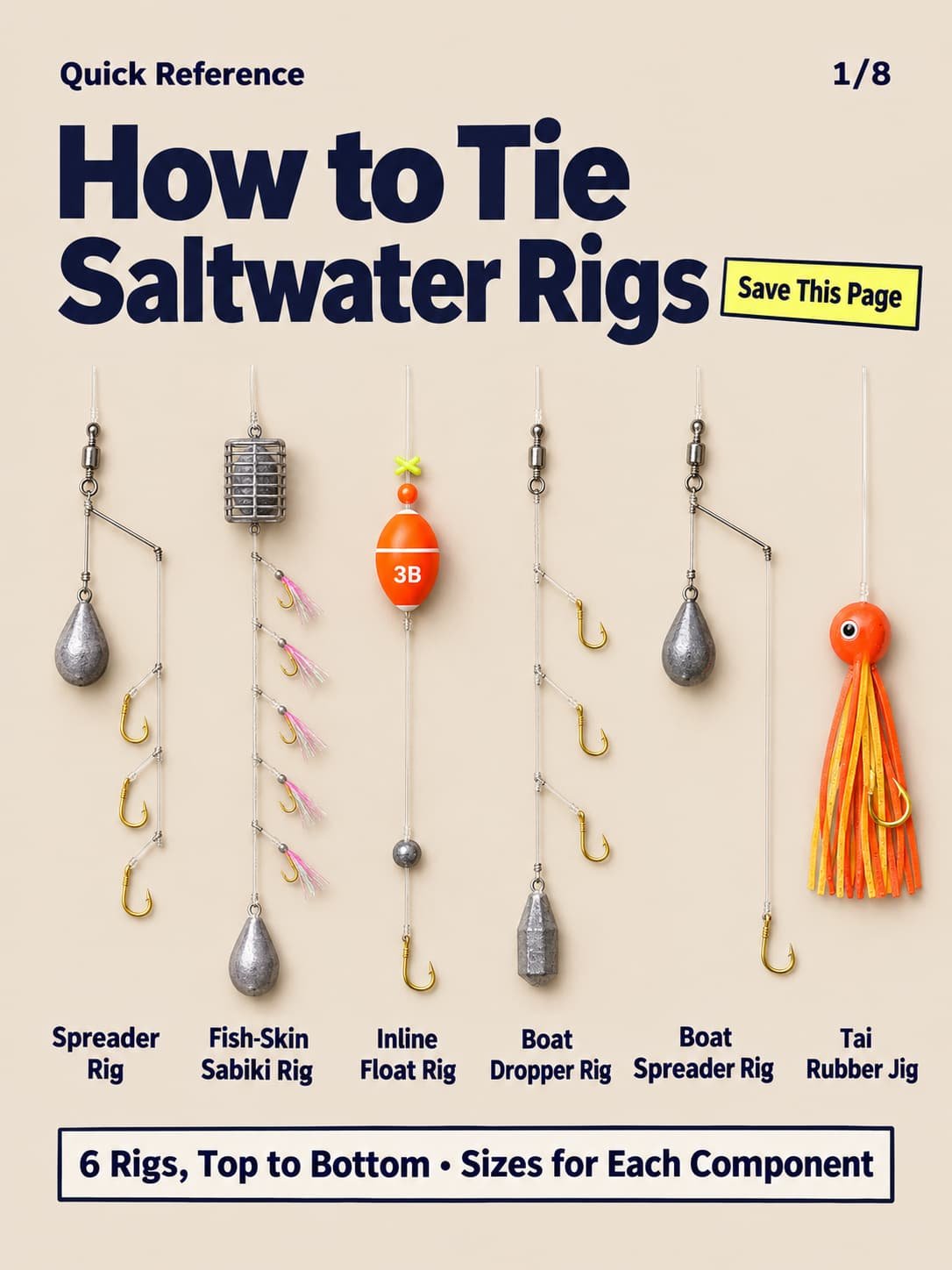
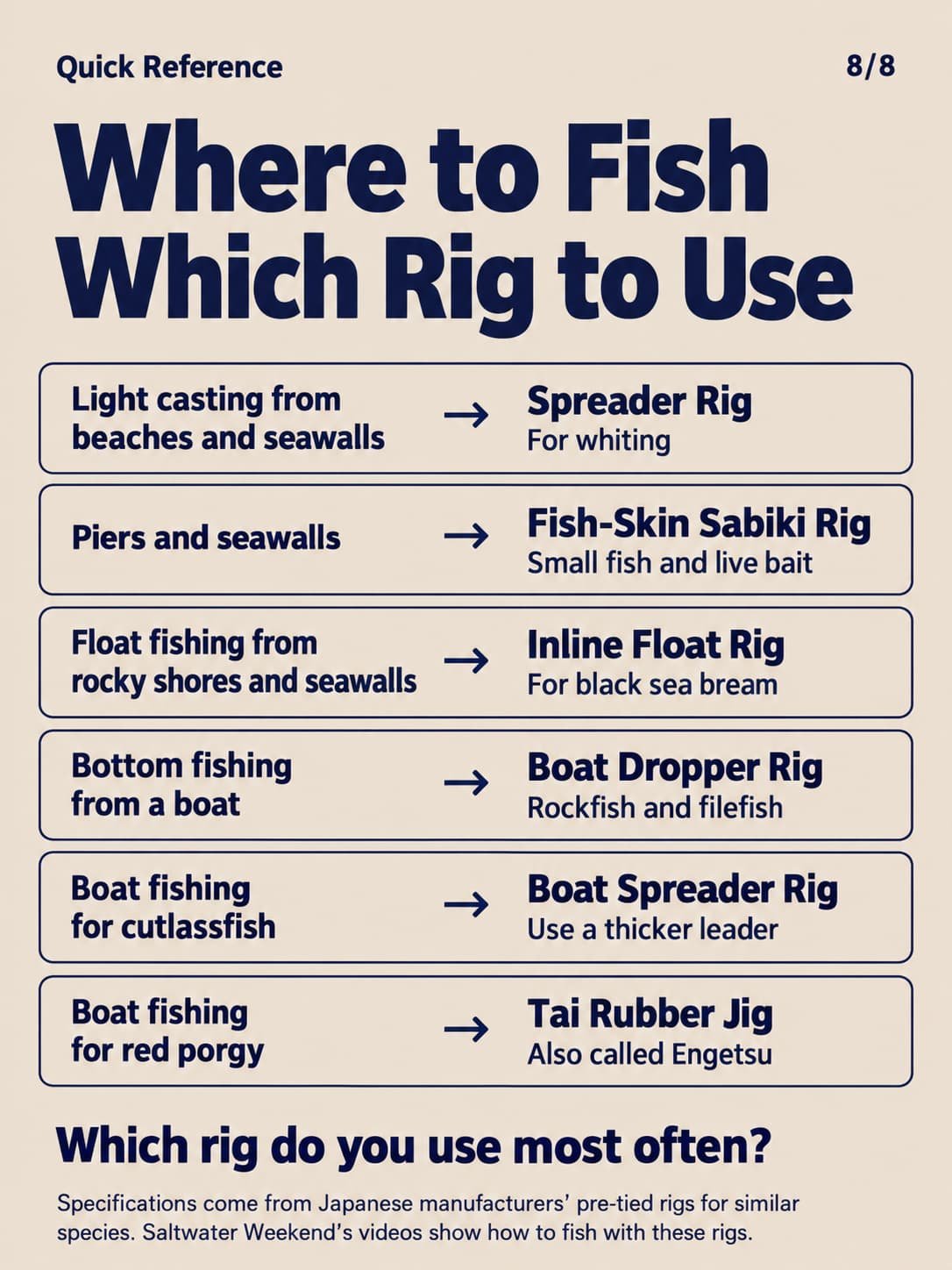
Choose a shore spreader rig for light beach casting, a sabiki for small fish around piers, and an inline float rig for bream along rocky shores. From a boat, use a dropper rig for bottom fishing, a large spreader rig for cutlassfish, or a tai rubber jig for sea bream.
| Fishing spot or approach | Rig | Target or purpose |
|---|---|---|
| Light casting from beaches or seawalls | Shore spreader rig | Whiting (US kingfish) |
| Piers and seawalls | Fish-skin sabiki rig | Small fish and live bait |
| Float fishing along rocky shores or seawalls | Inline float rig | Black bream |
| Boat bottom fishing | Boat dropper rig | Rockfish and filefish |
| Boat fishing with a fish-strip bait | Boat spreader rig | Cutlassfish, also called ribbonfish |
| Boat fishing with a skirted jig | Tai rubber jig | Sea bream, including red porgy |
The hook and sinker positions distinguish these setups. A spreader boom separates the sinker from the hooklength. A boat dropper rig places hooks on side branches above a bottom sinker. An inline float rig uses a stopper knot to set fishing depth.
How do you set up a shore spreader rig for whiting?
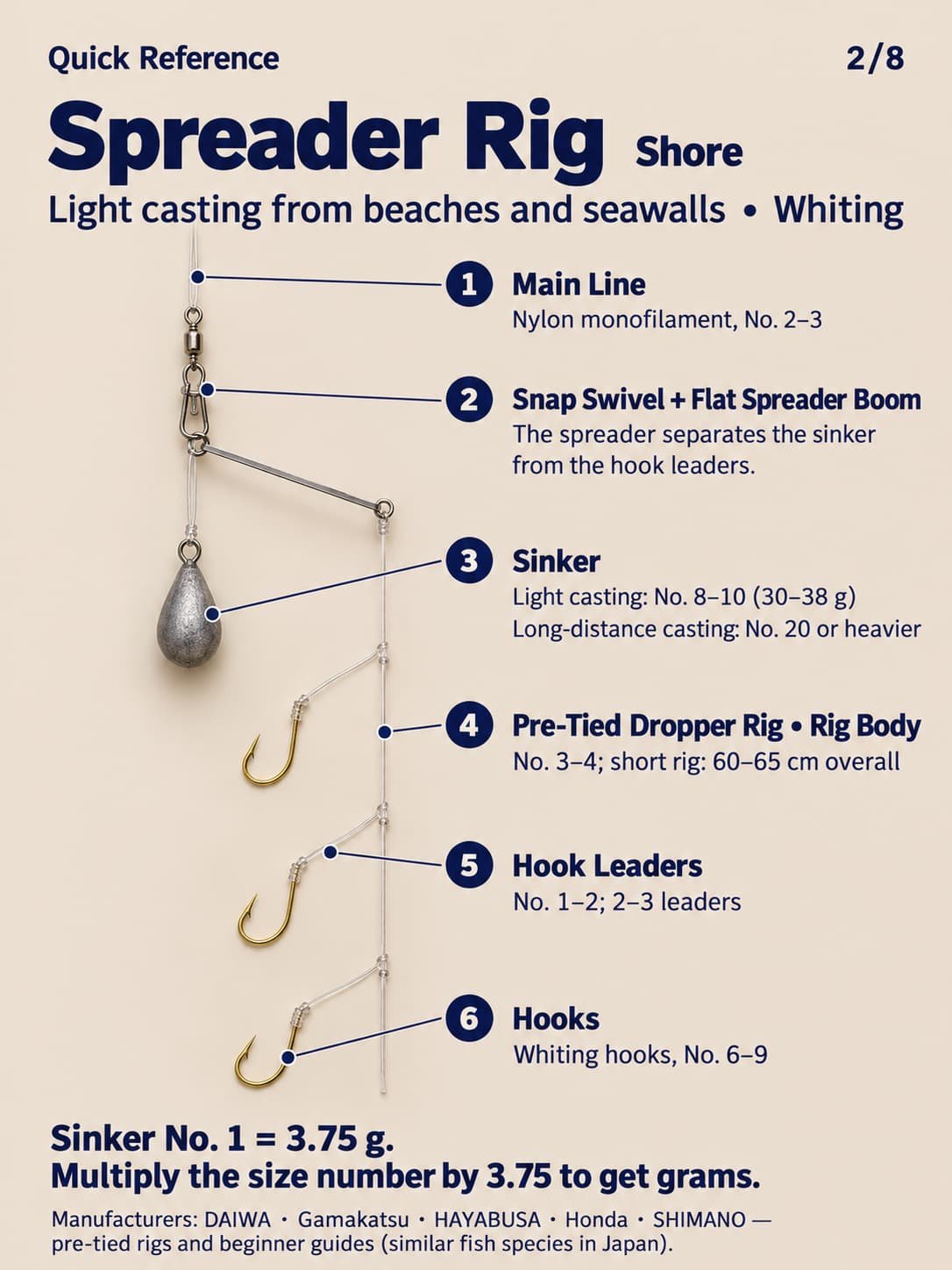
Use a shore spreader rig for light casting from a beach or seawall when targeting whiting. The spreader boom holds the sinker away from a short, ready-tied multi-hook rig. The compact setup uses a 30–38 g sinker for light casts and a multi-hook rig measuring 60–65 cm overall.
Assemble the shore spreader rig in this order.
- Main line - Use nylon monofilament in Japanese line sizes No. 2-3.
- Snap swivel and spreader boom - Connect the main line to the boom with a snap swivel. The boom separates the sinker from the multi-hook rig.
- Sinker - Use Japanese sinker sizes No. 8-10, shown as approximately 30-38 g, for light casting. The distance-casting option uses No. 20 or heavier.
- Rig body - Attach a ready-tied multi-hook rig with a body line in sizes No. 3-4. The short version measures 60-65 cm overall.
- Droppers - Use two or three side leaders in line sizes No. 1-2.
- Hooks - Use whiting-pattern hooks in Japanese sizes No. 6-9.
Japanese sinker numbers follow a weight conversion of 3.75 g per size number. No. 8 therefore weighs 30 g, while No. 10 weighs 37.5 g, rounded to 38 g in the setup. These sinker numbers describe weight and serve a different purpose from line or hook sizes.
How do you set up a fish-skin sabiki rig for pier fishing?
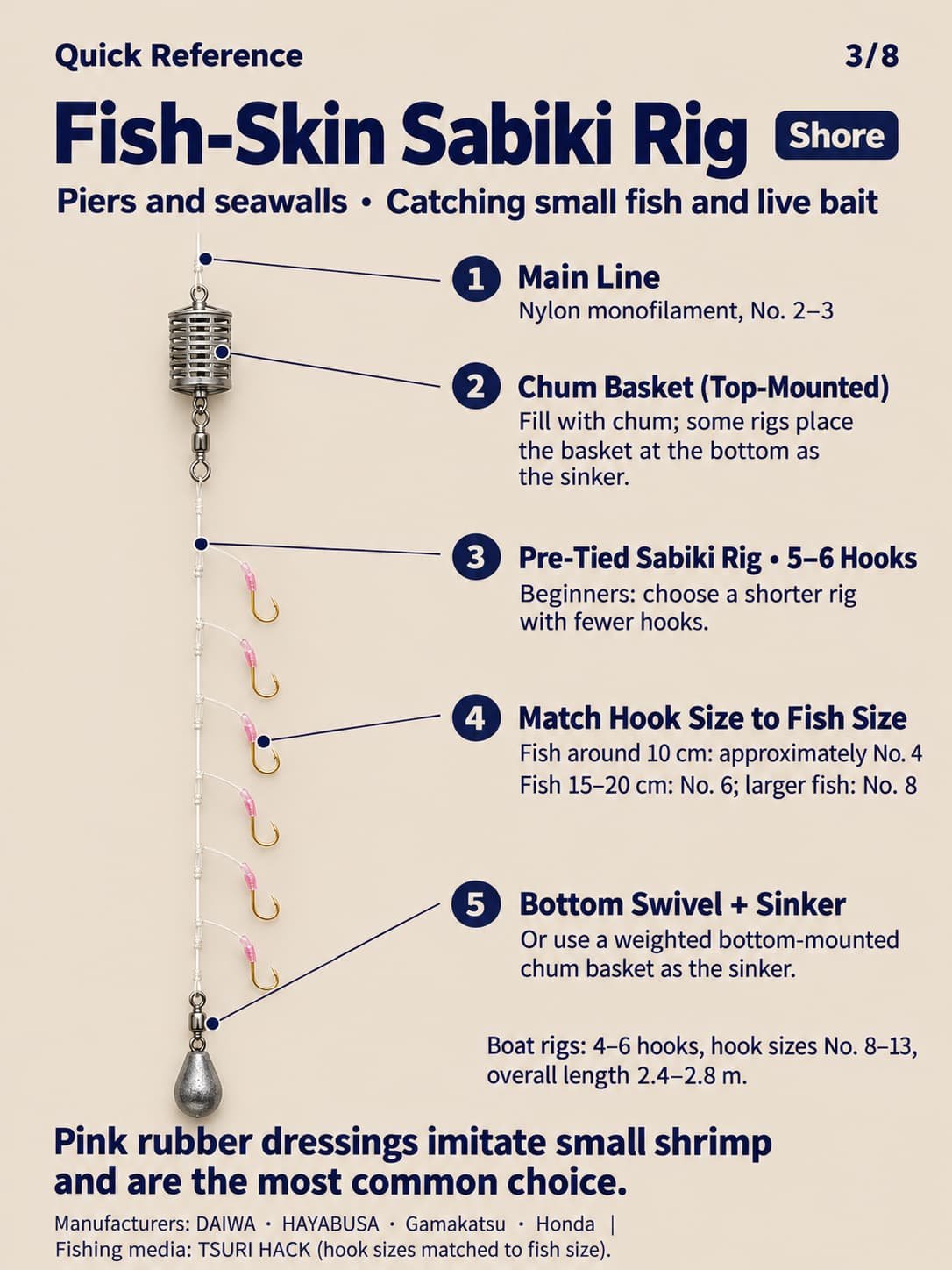
Use a fish-skin sabiki rig to catch small fish or collect live bait from piers and seawalls. The rig carries several small dressed hooks on short side branches, with a chum basket above and a sinker below. Start with a shorter rig and fewer hooks while learning to handle the setup.
A sabiki is a multi-hook bait-catching rig with small dressings on the hooks. The pink synthetic dressings imitate small shrimp.
- Main line - Use nylon monofilament in Japanese line sizes No. 2-3.
- Chum basket - Position the basket above the ready-tied multi-hook rig and fill the basket with chum. A weighted basket at the bottom provides an alternative arrangement.
- Ready-tied multi-hook rig - The standard rig carries five or six hooks. A shorter rig with fewer hooks offers a simpler starting point.
- Hook size - Match the hook pattern and size to the fish you intend to catch.
- Bottom connection - Connect a sinker to the lower swivel, or use a weighted bottom basket.
The hook-size examples increase with the target fish's length.
| Approximate fish length | Japanese sabiki hook size |
|---|---|
| Around 10 cm | Around No. 4 |
| 15–20 cm | No. 6 |
| Larger fish | No. 8 |
The boat version uses four to six hooks in Japanese sizes No. 8-13. The longer boat rig measures 2.4-2.8 m overall.
How do you set up an inline float rig for black bream?
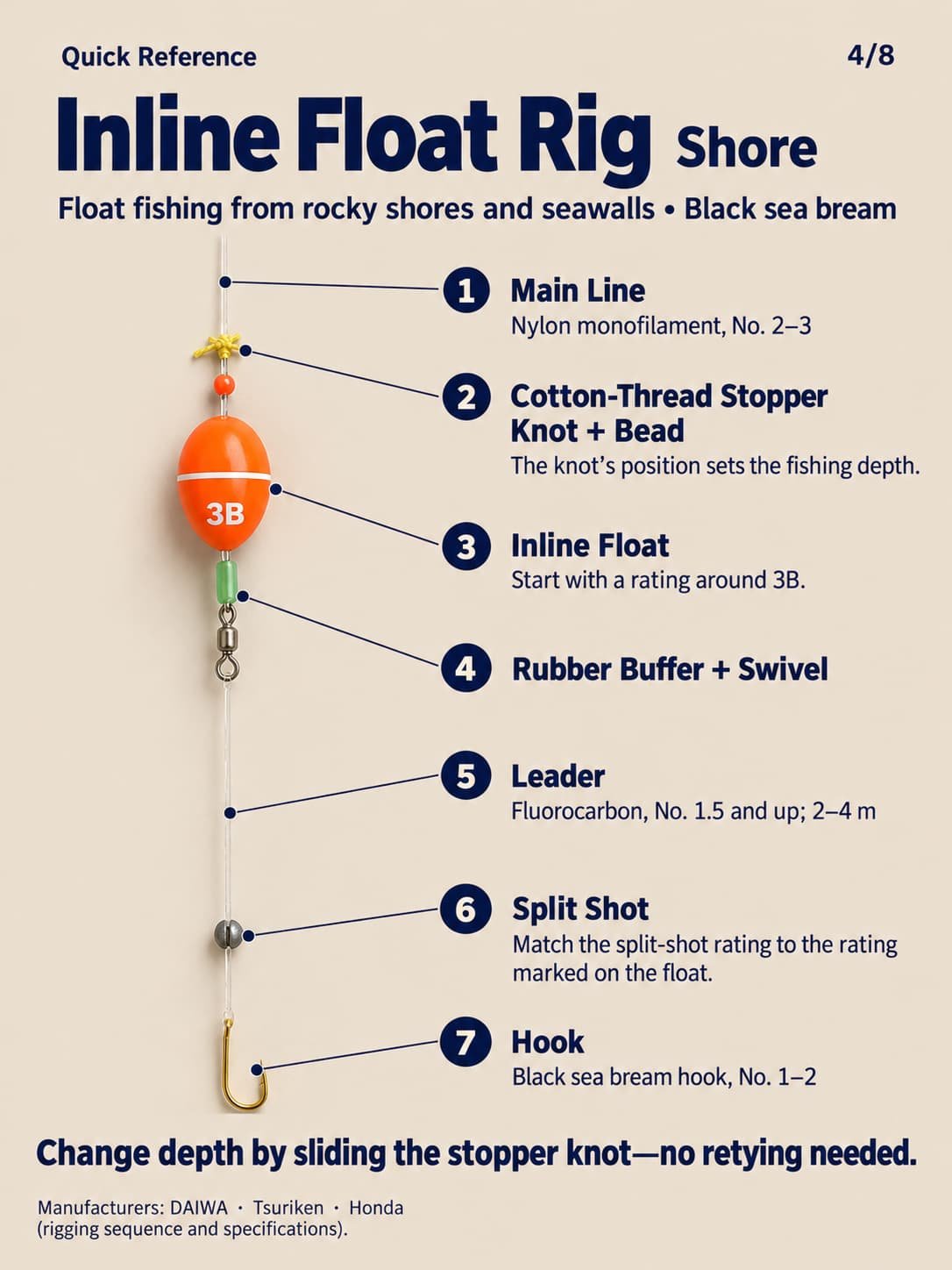
Use an inline float rig for black bream around rocky shores and seawalls. The main line passes through the float, while a stopper knot sets the fishing depth. A 3B float provides the starting point, with matching split shot and a fluorocarbon leader measuring 2–4 m.
Build the float rig from the reel toward the hook.
- Main line - Use nylon monofilament in Japanese line sizes No. 2-3.
- Stopper knot and bead - Fit the stopper knot above the bead. The knot's position controls how far the hook can settle below the float.
- Inline float - Start with a float rated around 3B.
- Rubber buffer and swivel - Place the buffer below the float, followed by the swivel.
- Leader - Connect a fluorocarbon leader in Japanese line size No. 1.5 or heavier. Use a leader length of 2–4 m.
- Split shot - Match the shot rating to the float's loading mark. A float marked 3B takes a matching 3B shot load.
- Hook - Finish with a black-bream-pattern hook in Japanese sizes No. 1-2.
Adjust the stopper knot to change the fishing depth without rebuilding the rig. Moving the stopper farther from the hook allows the hook to fish deeper. Moving the stopper closer to the hook sets a shallower depth.
The 3B mark describes the float's shot-loading rating. The mark does not mean that the float weighs 3 g.
How do you set up a boat dropper rig for bottom fishing?
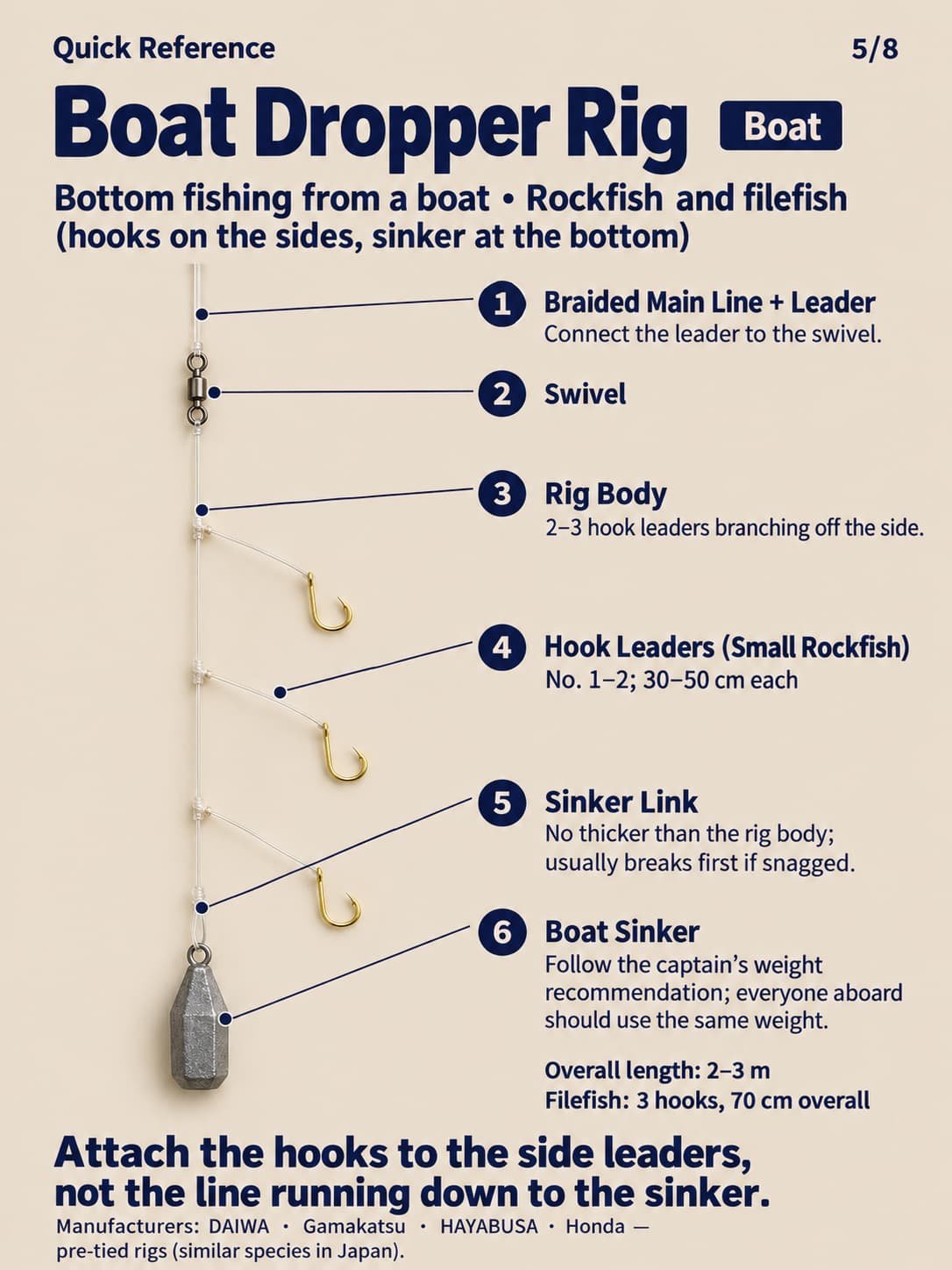
Use a boat dropper rig to target rockfish and filefish near the bottom. The hooks sit on side leaders, while the sinker hangs from the bottom of the rig body. The rockfish setup uses two or three droppers, each measuring 30-50 cm, on a rig measuring 2-3 m overall.
The rig body is the central length of line that carries the side leaders. Each side leader, or dropper, branches away from the body and ends at a hook. Anglers also call this general arrangement a paternoster rig.
- Main line and leader - Use a braided main line with a leader connected to the upper swivel.
- Upper swivel - Connect the leader to the rig body through the swivel.
- Rig body - Use a body carrying two or three side leaders for the rockfish setup.
- Side leaders - Use Japanese line sizes No. 1-2 for small rockfish, with each dropper measuring 30–50 cm.
- Sinker link - Use a sinker link no thicker than the rig body. The link may break first if the sinker snags, helping preserve the rest of the rig.
- Bottom sinker - Follow the skipper's weight recommendation. Anglers fishing together on the same boat should use the same sinker weight.
Attach each hook to a side leader, not to the line that runs down to the sinker.
The filefish version is shorter than the general rockfish setup. The compact filefish rig uses three hooks and measures 70 cm overall.
How do you set up a boat spreader rig for cutlassfish?
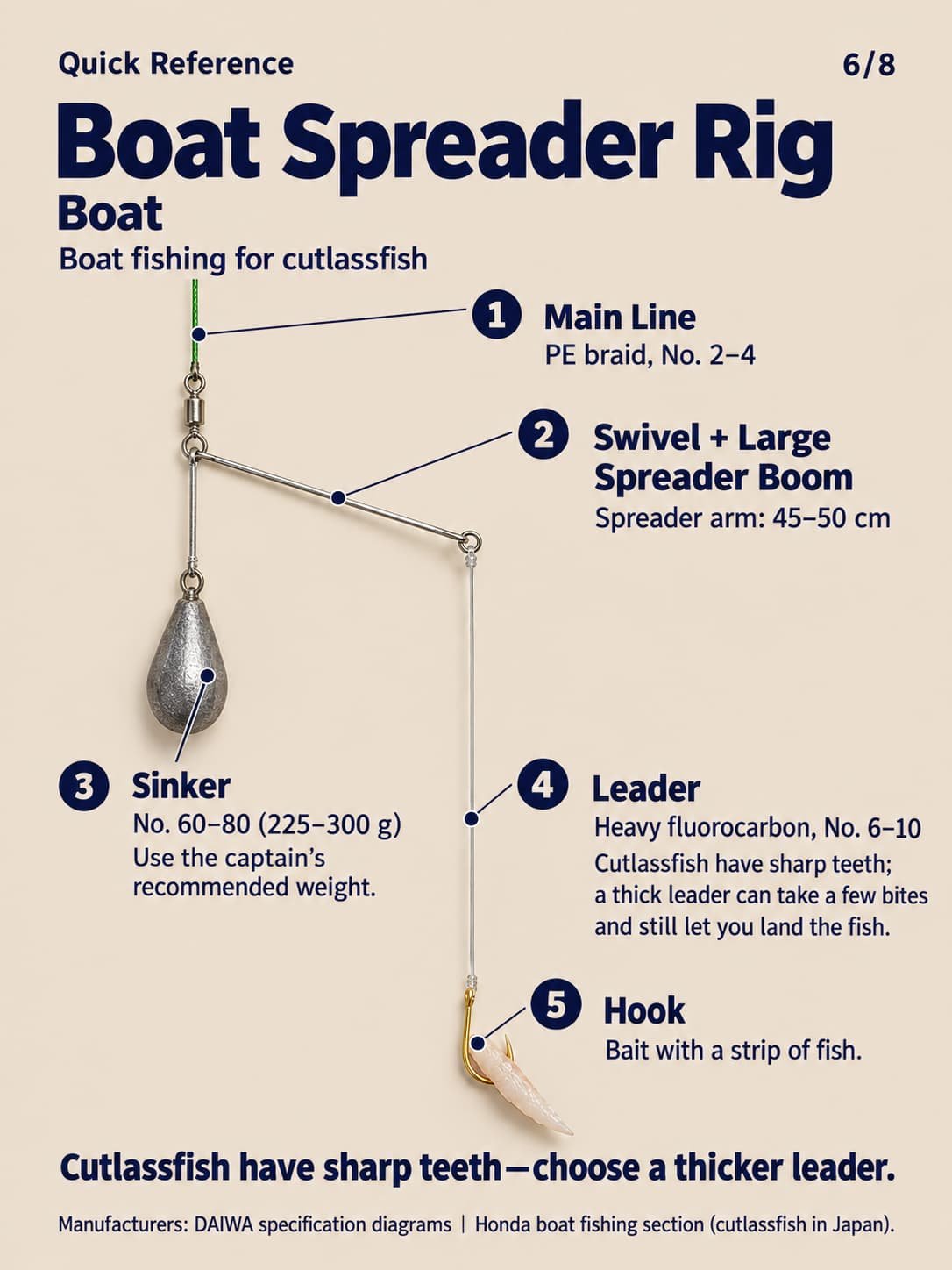
Use a large boat spreader rig when fishing for cutlassfish with strips of fish bait. The boom separates the sinker from a single-hook leader. The setup pairs a 45-50 cm boom with a 225-300 g sinker and a thicker fluorocarbon leader suited to the fish's sharp teeth.
Assemble the boat spreader rig in this order.
- Main line - Use PE No. 2-4 braid.
- Swivel and large spreader boom - Connect the main line to a swivel and a boom with an arm measuring 45–50 cm.
- Sinker - Attach a Japanese No. 60-80 sinker, equivalent to 225-300 g. Follow the skipper's choice of weight.
- Leader - Use thicker fluorocarbon in Japanese line sizes No. 6-10.
- Hook and bait - Attach a single hook and bait the hook with a strip of fish flesh.
Cutlassfish have sharp teeth, which is why this setup uses thicker fluorocarbon. The sinker hangs below the swivel, and the hook leader attaches to the end of the boom.
How do you set up a tai rubber jig for sea bream?
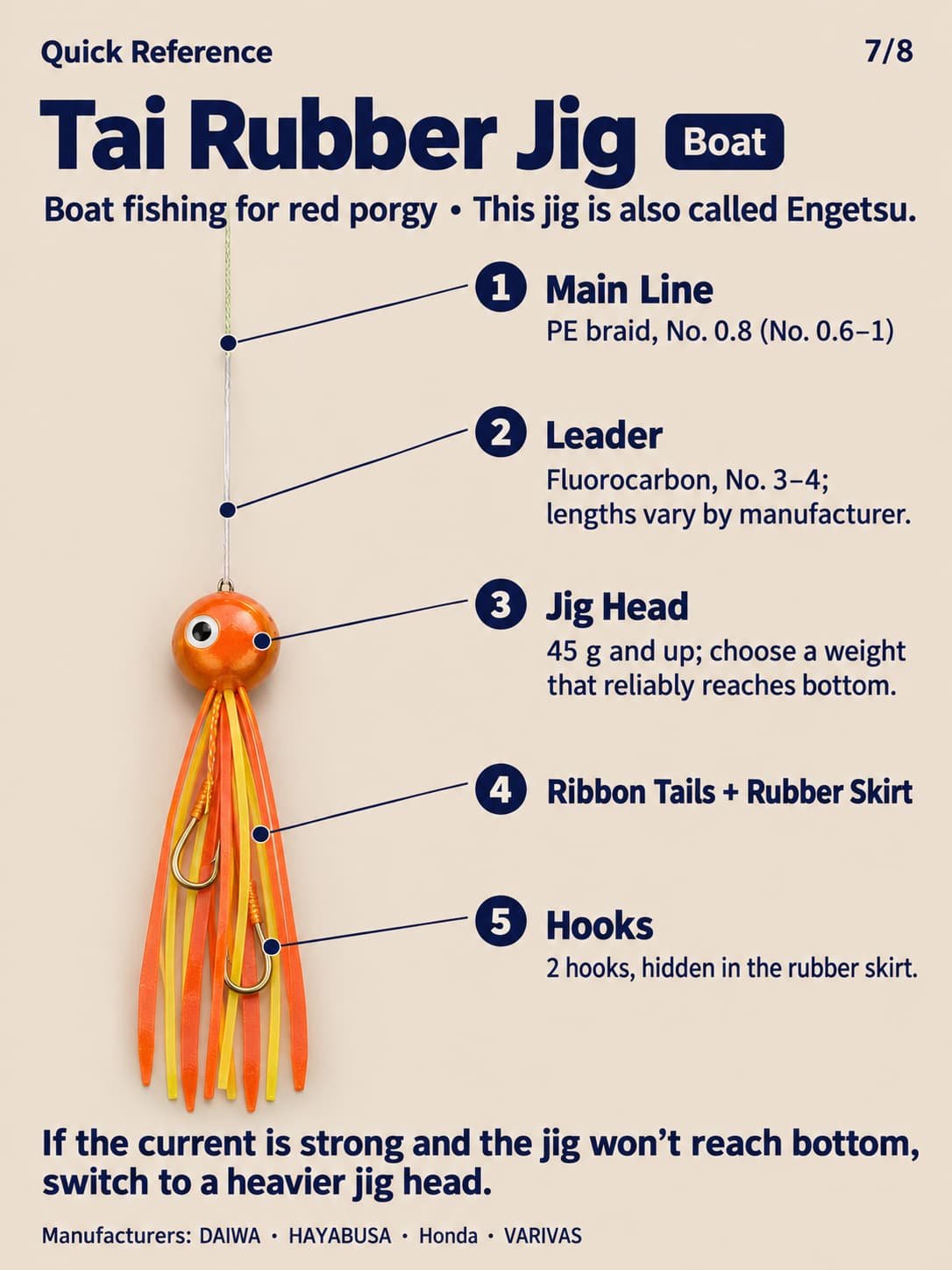
Use a tai rubber jig for boat fishing for sea bream, including red porgy. The lure combines a weighted head, flexible ribbons, a rubber skirt, and two assist hooks. Start with a head of 45 g or more and select enough weight to reach the bottom in the current.
A tai rubber jig is a skirted saltwater lure with small hooks tucked among flexible strands. The weighted head carries the lure down, while the ribbons and skirt form the trailing part of the lure.
- Main line - Use PE No. 0.8 braid as the starting point, within a PE No. 0.6-1.0 range.
- Leader - Connect a fluorocarbon leader in Japanese line sizes No. 3-4. Leader length varies between ready-made setups.
- Weighted head - Start at 45 g and choose a head heavy enough to reach the bottom reliably.
- Ribbons and skirt - Keep the flexible ribbons and rubber skirt together beneath the head.
- Assist hooks - Use two small hooks tucked within the skirt.
Switch to a heavier head when the current keeps the jig from reaching the bottom.
More to Explore
Related Articles
More guides in Fishing Gear
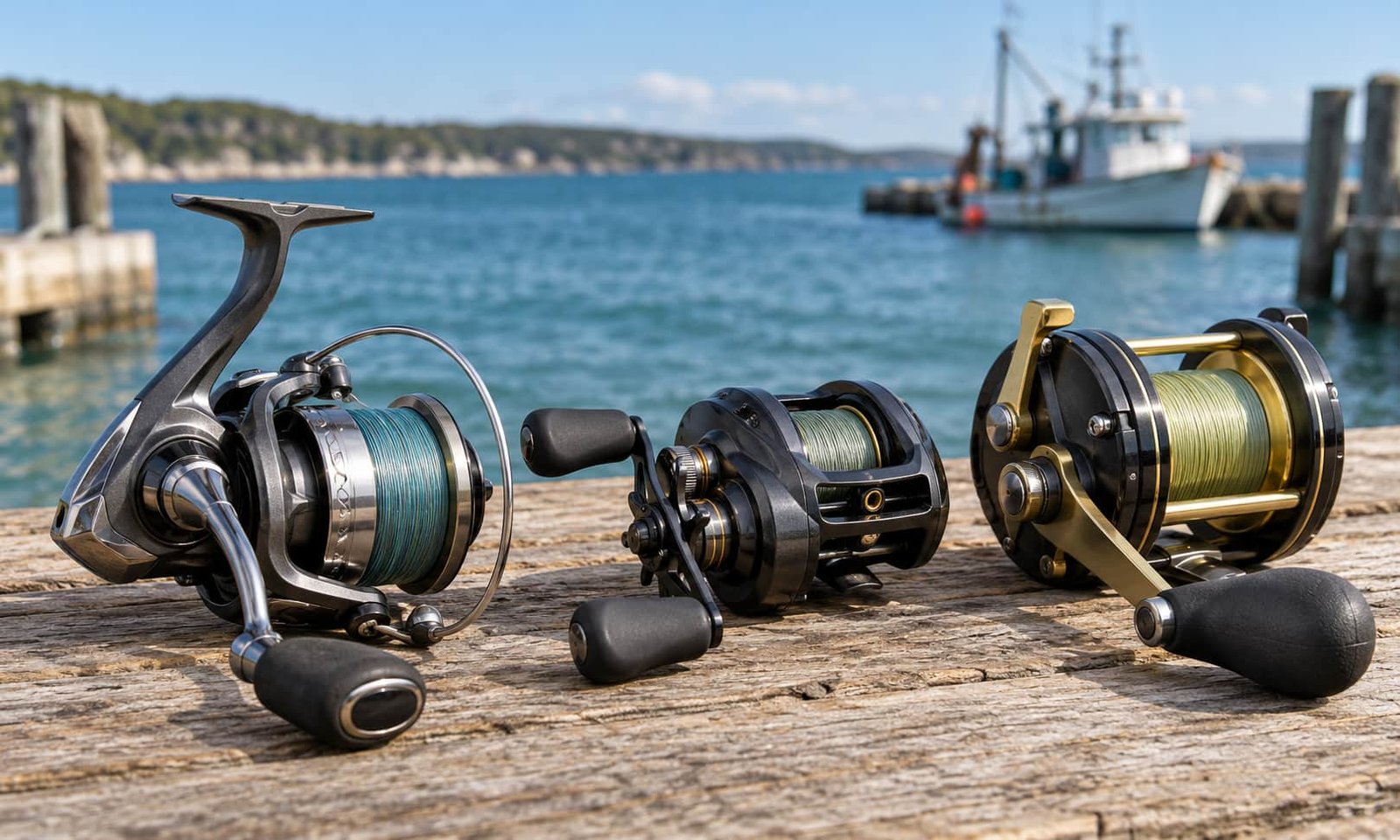
Learn how to choose a saltwater fishing reel for shore or boat fishing by comparing reel type, drag performance, and line capacity before you buy.
Build a bass fishing setup for beginners with a rod, braided line, and a leader that work together. Learn knots and casting before your first trip.
Learn how to choose a lure fishing rod by length, power, action, and lure weight. Find a practical starting setup before buying your first rod.
Learn how to adjust baitcaster brakes for better spool control, smoother casts, and fewer backlashes before you start pushing for more distance.
Not sure which rod to buy? Explore lure fishing gear for beginners, from rod length and power to reels, line, lures, and accessories.
Unsure what gear to buy first? This lure fishing setup for beginners guide covers spinning rods, reels, braid, fluorocarbon leaders, and lure weights.
Skip the crowded tackle bag. See which rod, reel, fishing line, and starter lures help you learn faster on the water.
Not sure which rig to tie on? See the difference between jig head and Ned hook before choosing your next soft bait setup.