How to Choose a Lure Fishing Rod Without Buying Twice
- Category
- Fishing Gear
- Date
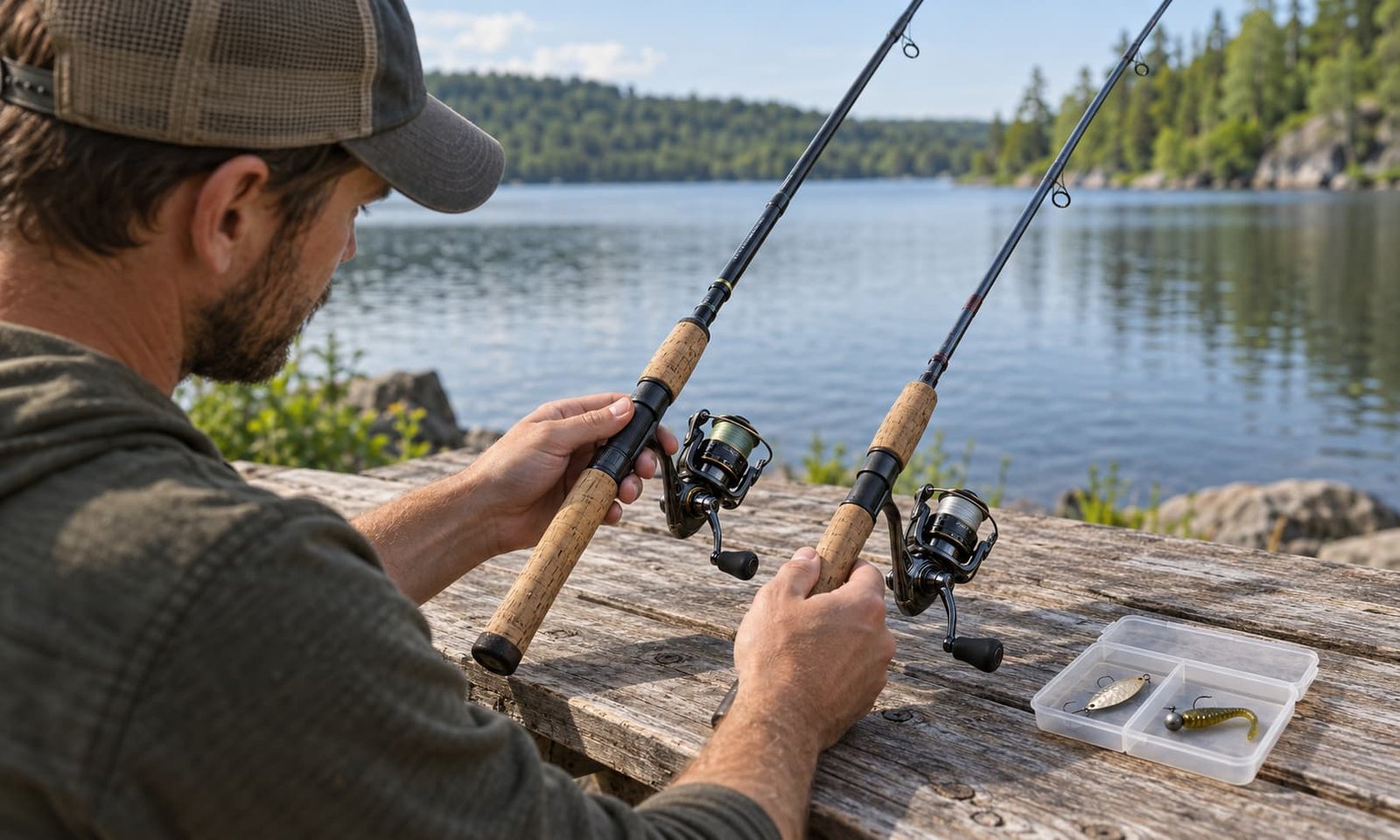
Your first lure rod should match the water you actually fish most often. A narrow trout creek, a tree-lined riverbank, and an open reservoir all demand different things from rod length, casting room, lure weight, and fish control.
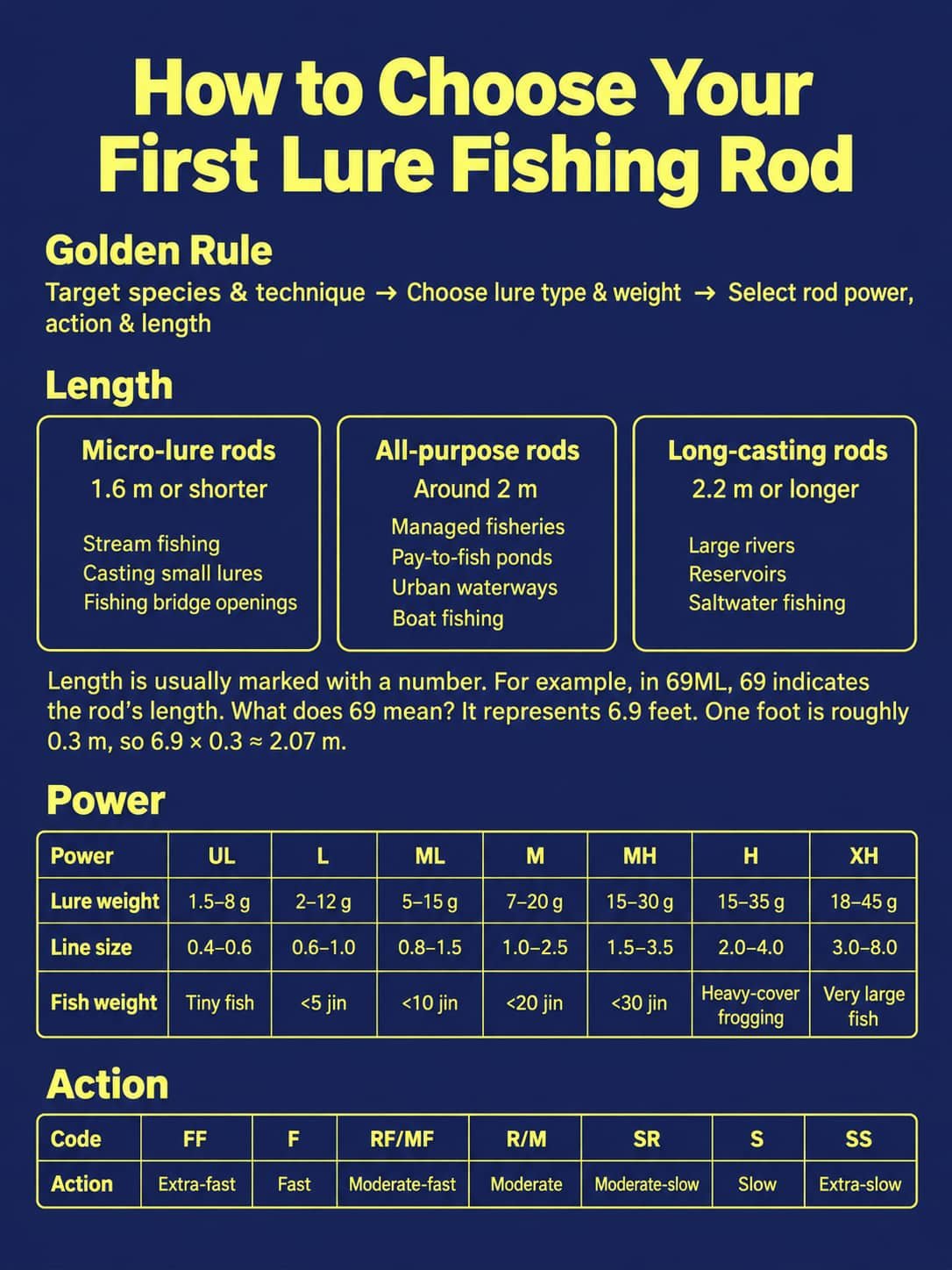
Learning how to choose a lure fishing rod becomes much easier when you break the decision into three basics: length, power, and action. Length affects casting reach and handling, power describes how much force it takes to bend the rod, and action tells you where that bend begins.
Match those three features to your fishing style and water first, then worry about price.
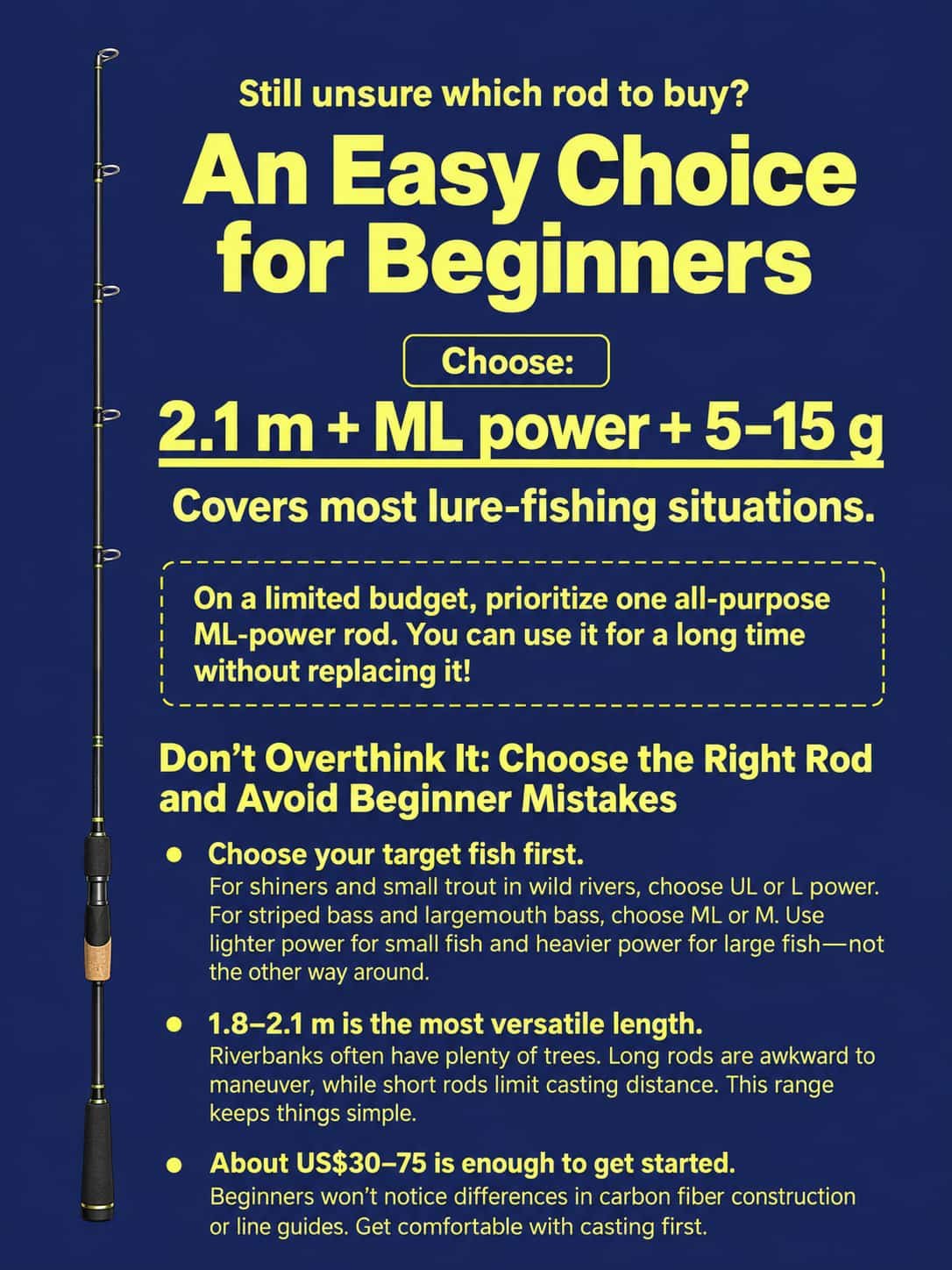
What should you decide before choosing a lure rod?
Start with your target fish and fishing technique, then choose the lure type and weight. Use those decisions to select rod power, action, and length. A rod chosen around your regular fishing gives you a clearer starting point than a rod bought simply because the specifications look impressive.
Follow this order:
- Identify the fish and the water. Consider small trout in a creek, perch along a lake bank, or bass around vegetation.
- Choose the presentation. Decide whether you will use tiny spoons, small hard baits, soft plastics, or heavier lures.
- Match the rod. Check the lure rating, then choose the bend and length that suit your technique and casting space.
The lure weight connects the fish you want to catch with the rod you need. Small fish on tiny lures call for a different starting setup from large predators on heavy baits.
How long should your lure fishing rod be?
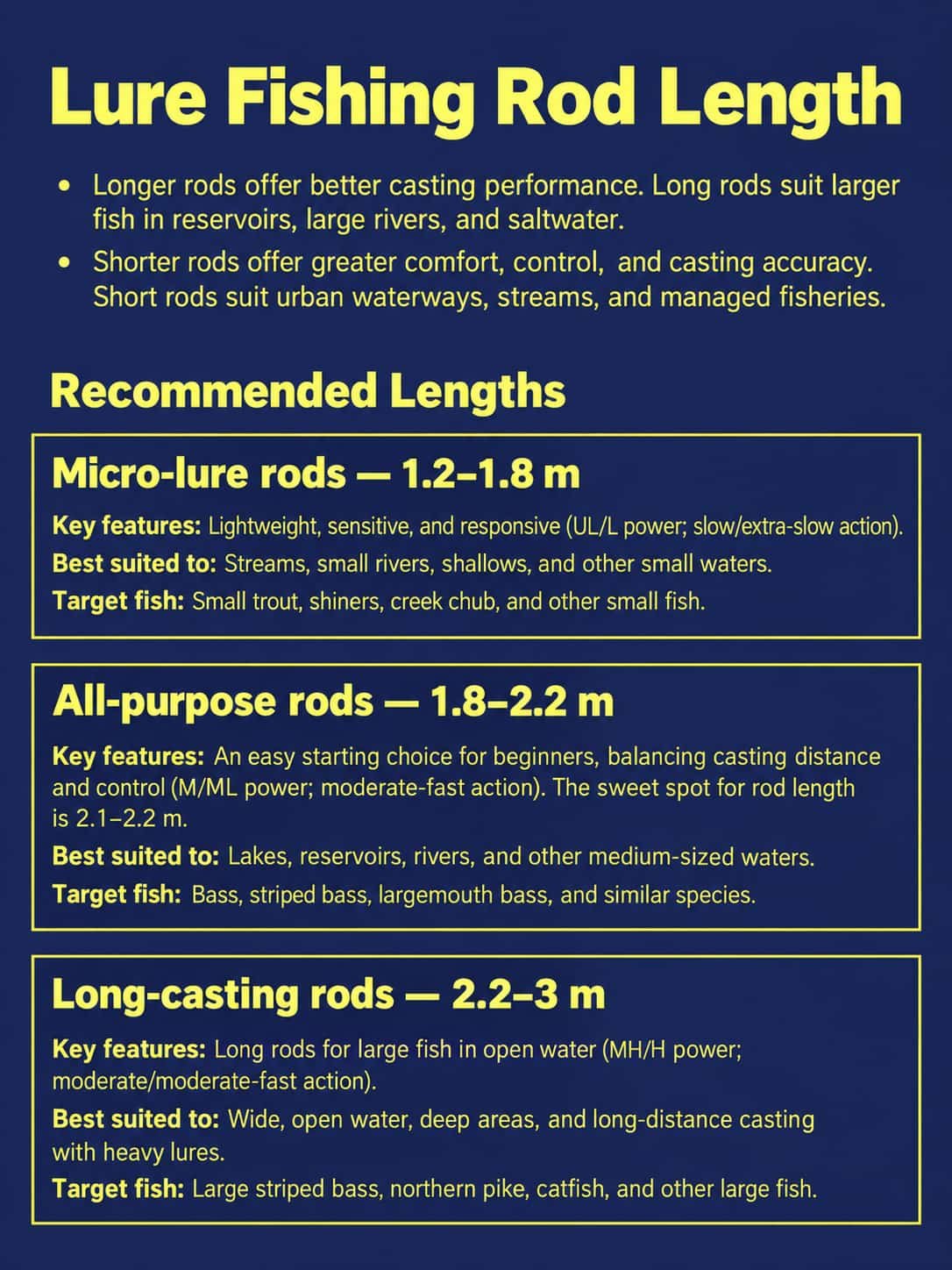
Choose a rod length that fits your casting space and the distance you need to reach. Shorter rods are easier to manage around close targets and restricted banks. Longer rods can help on open water. For general freshwater fishing, the 1.8–2.2 m range offers a practical balance between reach and control.
These length bands provide useful starting points:
| Rod category | Length | Approximate imperial equivalent | Typical setting |
|---|---|---|---|
| Short rods for micro lures | 1.2–1.8 m | 4–6 ft | Small creeks, narrow rivers, and close presentations |
| General-purpose rods | 1.8–2.2 m | 6 ft–7 ft 3 in | Lakes, reservoirs, and rivers |
| Longer rods for casting reach | 2.2–3.0 m | 7 ft 3 in–9 ft 10 in | Open banks and larger stretches of water |
A length around 2.1-2.2 m is worth considering when you want one rod for several freshwater locations. A shorter choice within the general-purpose range can make more sense when trees restrict your casting stroke.
When does a shorter rod make fishing easier?
A shorter rod helps when branches, narrow paths, or nearby targets limit the space available for casting. For a beginner fishing a tree-lined riverbank, 1.8-2.1 m offers a manageable starting range. Rods around 1.2-1.8 m are more specialized options for tight creeks and short casts with small lures.
A close target rewards control more than maximum casting distance. When you need to place a small spoon beside a nearby bank, choose a length that lets you complete the cast comfortably without catching the rod tip in branches.
When is a longer rod worth choosing?
A longer rod is worth considering when an open shoreline gives you room to cast and the fish-holding water lies farther out. The 2.2-3.0 m range provides options for that setting. Match the casting rating separately, because additional length does not automatically make a rod suitable for heavier lures.
Casting distance depends on the whole setup. The lure must load the rod appropriately, and the angler still needs a controlled casting stroke. Buying a longer rod cannot compensate for a badly matched lure weight.
What rod power matches your lures and target fish?
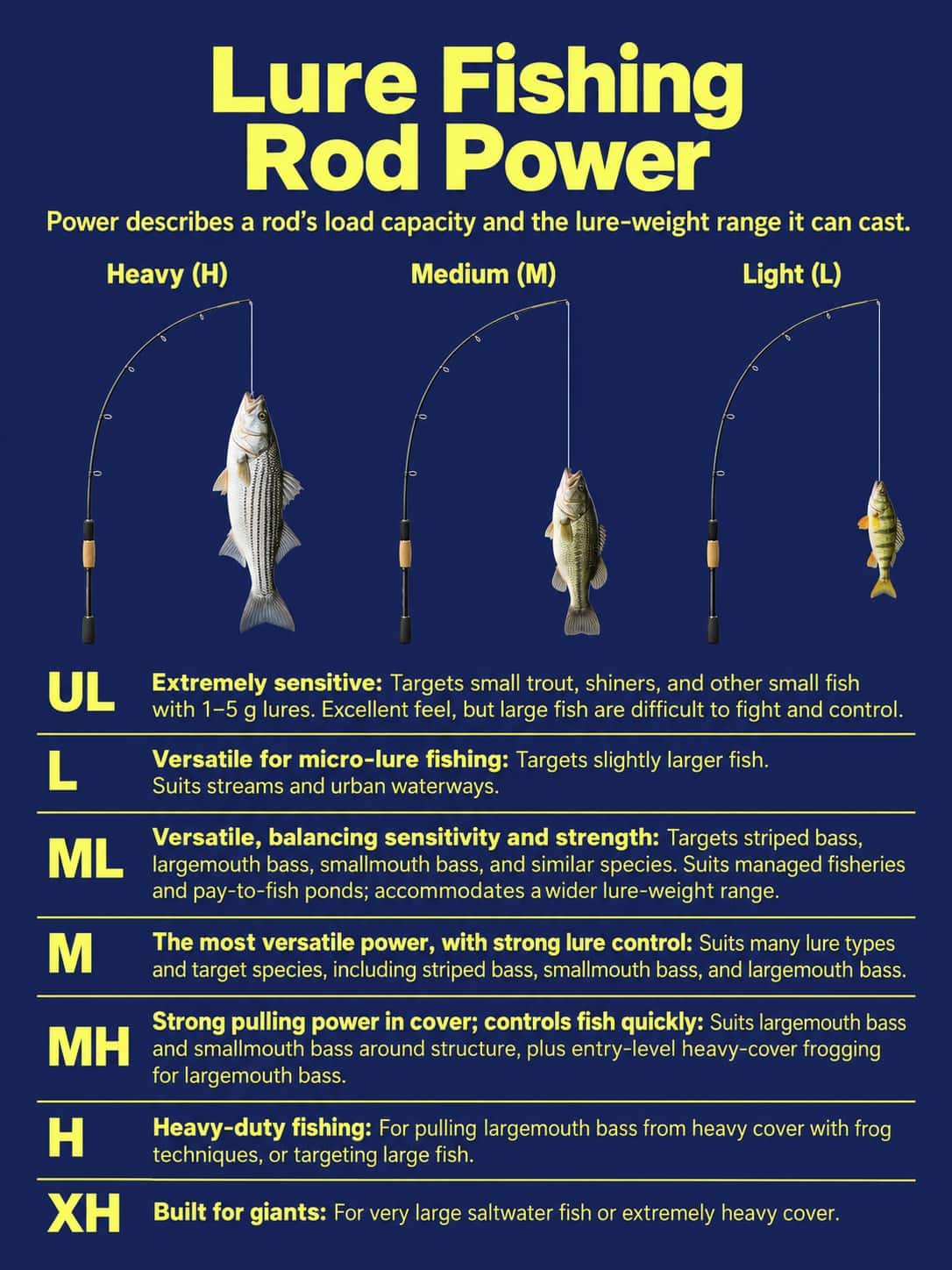
Rod power describes the force required to bend the rod. Choose lighter power for smaller lures and heavier power when lure weight or fishing cover demands more control. The usual progression runs from UL to XH. A power code helps narrow the selection, but the printed casting rating determines the recommended lure range.
The following comparison ranges show the progression from lighter to heavier presentations. These figures are starting references, not universal specifications for every rod carrying the same power code.
| Code | Power | Illustrative lure-weight range | General role |
|---|---|---|---|
| UL | Ultralight | 1.5-8 g | Micro lures and delicate presentations |
| L | Light | 2-12 g | Small lures in creeks and rivers |
| ML | Medium-light | 5-15 g | Light freshwater fishing with a broader lure selection |
| M | Medium | 7-20 g | General freshwater lure fishing |
| MH | Medium-heavy | 15-30 g | Heavier presentations and more demanding cover |
| H | Heavy | 15-35 g | Stronger control around heavy cover |
| XH | Extra-heavy | 18-45 g | More powerful, specialized applications |
Power ratings overlap because the letters describe a category rather than a fixed casting range. A particular heavy or extra-heavy rod may carry a substantially different lure rating from the figures above. Read the numbers on the actual rod before buying.
Rod power also does not define a maximum fish weight. Lure weight, line, drag, available space, and obstacles all affect the demands placed on a rod during a fight.
Should a beginner choose UL, ML, or M?
Choose UL when tiny lures are central to your fishing, ML when you mostly use lighter freshwater presentations, and M when your regular lures require a higher casting range. The micro-lure starting point is around 1-5 g, while the beginner ML recommendation centers on 5-15 g. Confirm the rating on each rod.
For a trout creek or small panfish water, an appropriately rated UL or L rod keeps the setup suited to small lures. For perch or bass in relatively open water, ML or M may suit a wider selection of presentations.
Heavy cover changes the decision. Cover means vegetation or other objects where fish can shelter. Dense weeds and submerged timber can demand more control than open water, even when the lure itself is not especially heavy.
How do you match lure weight to the rod’s casting rating?
Match the complete weight you cast to the rod’s recommended lure range. North American rods often call that specification a lure rating, while European rods commonly use casting weight. A 5-15 g rating describes the intended casting range. Count the complete lure or rig, including any added jig head or sinker.
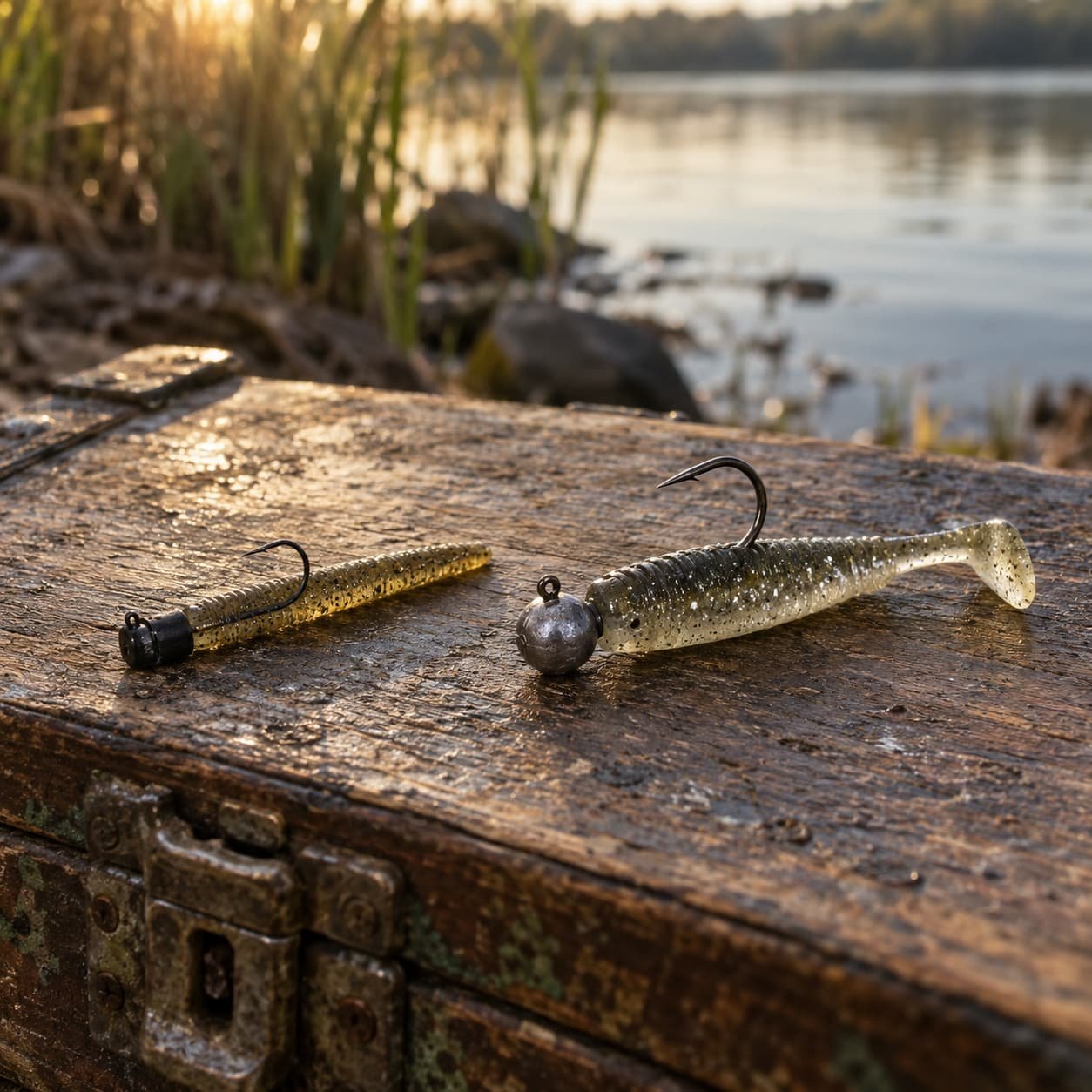
A rig is the assembled arrangement of line, hook, lure, and any added weight. When you fish a soft plastic on a jig head, the casting weight includes both the jig head and the plastic.
Use a 5–15 g rod as a simple comparison:
| Complete lure or rig weight | Relationship to a 5–15 g rating |
|---|---|
| 5 g | At the lower end |
| 15 g | At the upper end |
| 20 g | Above the recommended range |
A rod should suit the lures you use most often. If your regular presentations weigh 1-5 g, look for a rating that covers those lighter weights. If your regular lures weigh 15-30 g, choose a rod intended for that heavier range.
The 5-15 g range is approximately 0.18-0.53 oz. Keep the units clear when comparing a rod labeled in grams with a rod labeled in ounces.
What does rod action tell you about the bend?
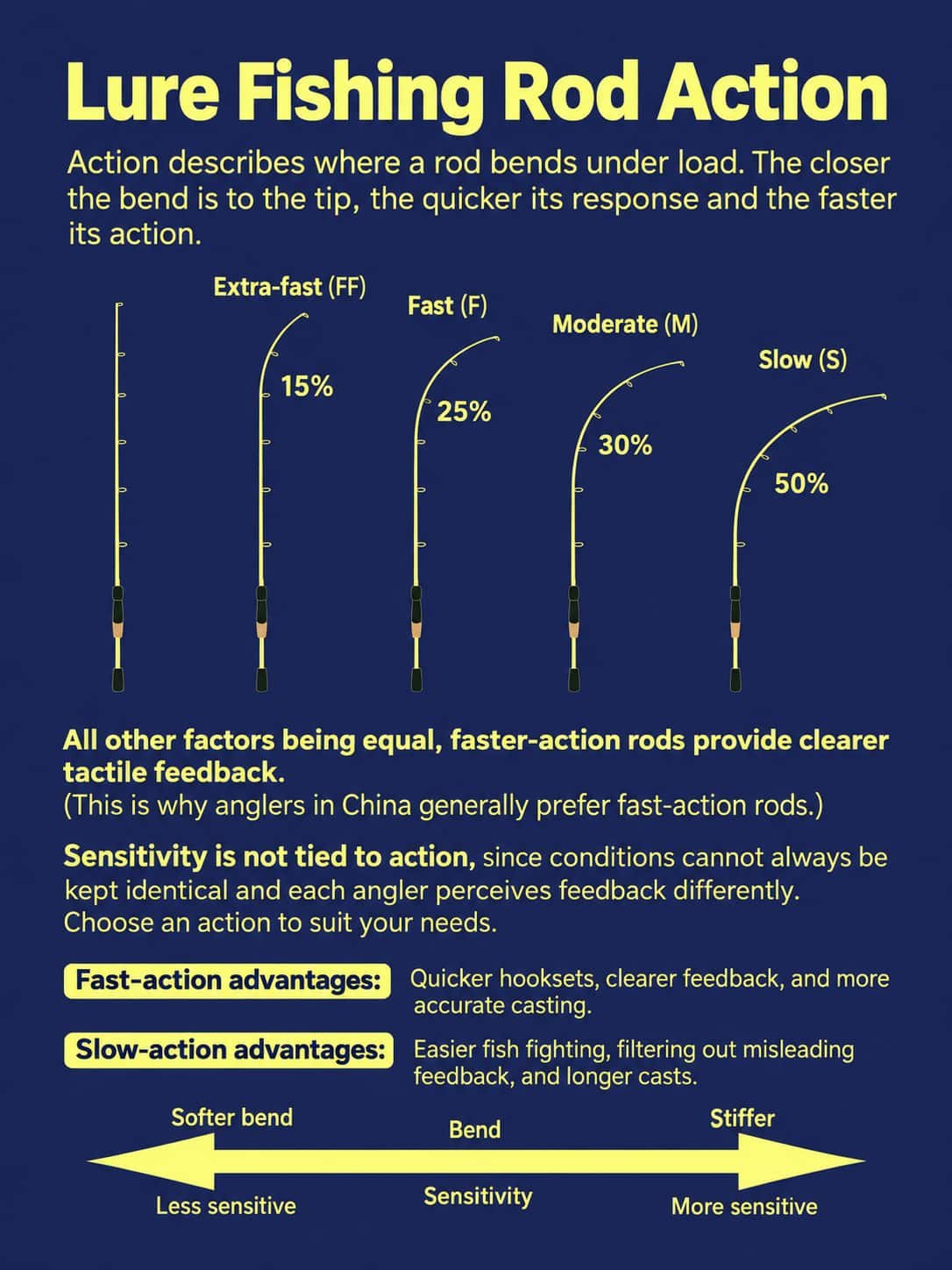
Rod action describes where the rod bends under load. Extra-fast and fast actions concentrate more of the initial flex near the tip. Moderate and slow actions bend progressively deeper into the blank. Choose the bend according to how you work the lure, set the hook, and maintain pressure on a hooked fish.
The blank is the main structural body of the rod. Power describes how much force bends that body; action describes where the bend develops.
| Action marking | Common name | General bend pattern |
|---|---|---|
| XF or FF | Extra-fast | Initial flex closest to the tip |
| F | Fast | Initial flex mainly in the upper section |
| MF or RF | Moderate-fast or regular-fast | A transition between fast and moderate |
| M or R | Moderate or regular | A deeper bend toward the middle |
| SR | Moderate-slow | A transition toward a deeper, slower bend |
| S | Slow | A progressive bend farther down the blank |
| SS | Extra-slow | A particularly deep, progressive bend |
Action names and abbreviations vary. Always read the action field alongside the power field, because M power means medium power, while M action may mean moderate action.
Bend-diagram percentages such as 15%, 25%, 30%, and 50% illustrate differences in flex location. Treat those percentages as visual guidance rather than standardized measurements that apply to every rod.
When is fast action useful?
Fast action is useful when you want direct lure control and a prompt hookset. Single-hook jigs and soft plastics are common situations where that response helps. A fast-action rod gives the angler a tip section for working the lure while bringing the stronger lower section into play as load increases.
A fast-action label does not guarantee superior sensitivity. The blank, components, line, and contact with the lure also affect the feedback reaching your hand. Choose action for the presentation rather than treating “fast” as a general quality ranking.
When does a deeper bend help?
A deeper bend helps cushion headshakes and sudden runs after a fish takes the lure. Moderate and moderate-fast actions can be useful with treble-hook lures because the rod absorbs changes in pressure. A more forgiving bend gives the angler additional cushioning while keeping the line under tension during the fight.
A slower bend still needs to suit the lure and hookset. Choose the action that lets you work the presentation properly, rather than assuming a slow-action rod will always cast farther or land fish more easily.
How do you read a rod code such as 69ML?
Read a rod code as a shorthand description, then confirm the full specifications. In a common feet-and-inches naming system, 69 indicates 6 feet 9 inches and ML indicates medium-light power. The action and lure rating remain separate details. A short model code does not always contain every specification you need.
A 6 ft 9 in rod measures approximately 2.06 m. The number 69 in this naming system does not mean 6.9 decimal feet.
Keep these details separate when checking the rod:
- Length: The overall rod length, stated in feet and inches or meters.
- Power: A designation such as UL, L, ML, M, MH, H, or XH.
- Action: A designation such as fast, moderate-fast, or moderate.
- Lure rating: The recommended casting range in grams or ounces.
- Line rating: The recommended line specification, read in the units provided.
ML describes power, not action. A medium-light rod can have a fast, moderate-fast, or other action depending on the design.
What is a sensible first rod for light freshwater fishing?
For a beginner using smaller lures in relatively open freshwater, a rod around 2.1 m long with ML power and a 5–15 g casting rating is a useful starting point. The combination balances manageable length with light-lure versatility. Choose the action separately according to the presentations you expect to fish most often.
Use this starting setup when the lure weights and fishing conditions fit:
| Specification | Starting point |
|---|---|
| Length | Around 2.1 m, roughly 6 ft 11 in |
| Power | Medium-light |
| Lure rating | 5–15 g |
| Action to consider | Fast or moderate-fast, depending on the lure |
| Intended context | Light freshwater presentations without demanding heavy cover |
The recommendation can suit perch, trout, panfish, and bass when the actual lures fall within the casting range. The species name alone does not determine the rod; the presentation and fishing location complete the decision.
Change the setup when the fishing demands change. Tiny creek lures may call for a lighter-rated rod. Large pike lures, substantial current, or dense vegetation may call for more power and a higher casting range.
How much should you spend on your first lure rod?
Use about US$30–75 for the rod alone as an approximate starting budget, subject to local availability and pricing. Prioritize a suitable casting range, manageable length, and comfortable handling. Budget separately for the reel, line, and lures. A higher price does not make an unsuitable rod a better match for your fishing.
Casting practice deserves attention before frequent upgrades. Differences in blank materials and guide components may matter more as you develop preferences, but the first priority is learning to cast your regular lures with control.
One appropriately chosen general-purpose rod can support that learning. Add another rod when a regular technique creates a clear need for different specifications, rather than replacing the first rod before you understand its useful range.
What should you check before buying the rod?
Check the rod against your regular lure weights, casting space, fishing cover, and preferred presentations before buying. Keep length, power, and action separate during the comparison. A clear match between the rod and your usual fishing gives you a useful first setup and makes future tackle decisions easier to explain.
Use this final checklist:
- Target fish and technique: Decide what you will fish for and how you will present the lure.
- Complete casting weight: Include the lure and any attached weight.
- Rod power: Match the presentation and the control required around cover.
- Rod action: Match lure control, hook style, and the cushioning you need.
- Rod length: Allow for the distance you need and the space available to cast.
- Reel compatibility: Confirm that the rod suits the reel you intend to use.
A useful first rod earns its place through regular use. Choose a manageable setup for familiar water, learn how the rod casts your usual lures, and let those fishing sessions guide the next purchase.
More to Explore
Related Articles
More guides in Fishing Gear
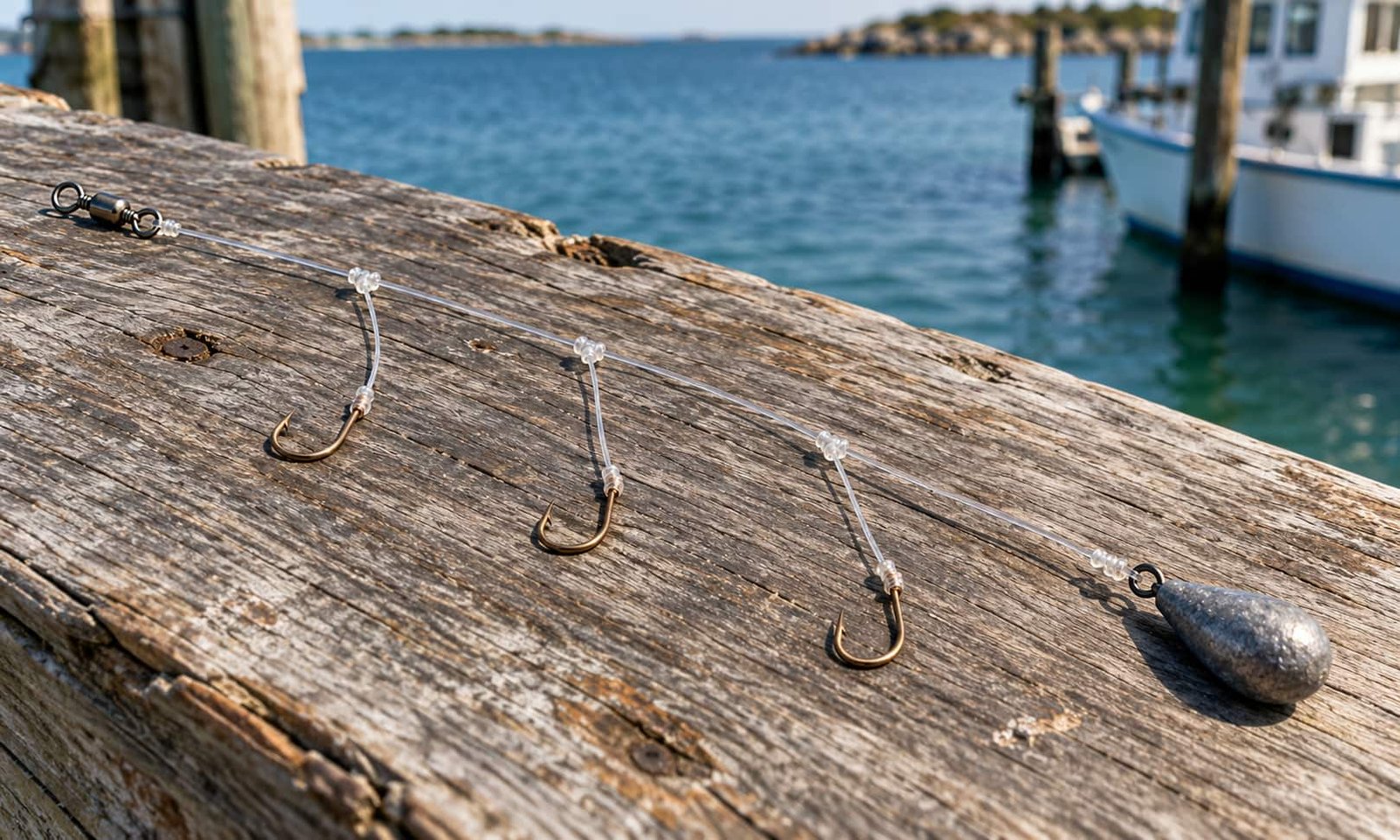
Take a closer look at 6 saltwater fishing rigs, from shore setups to boat rigs, with diagrams that show how the lines, hooks, and sinkers connect.
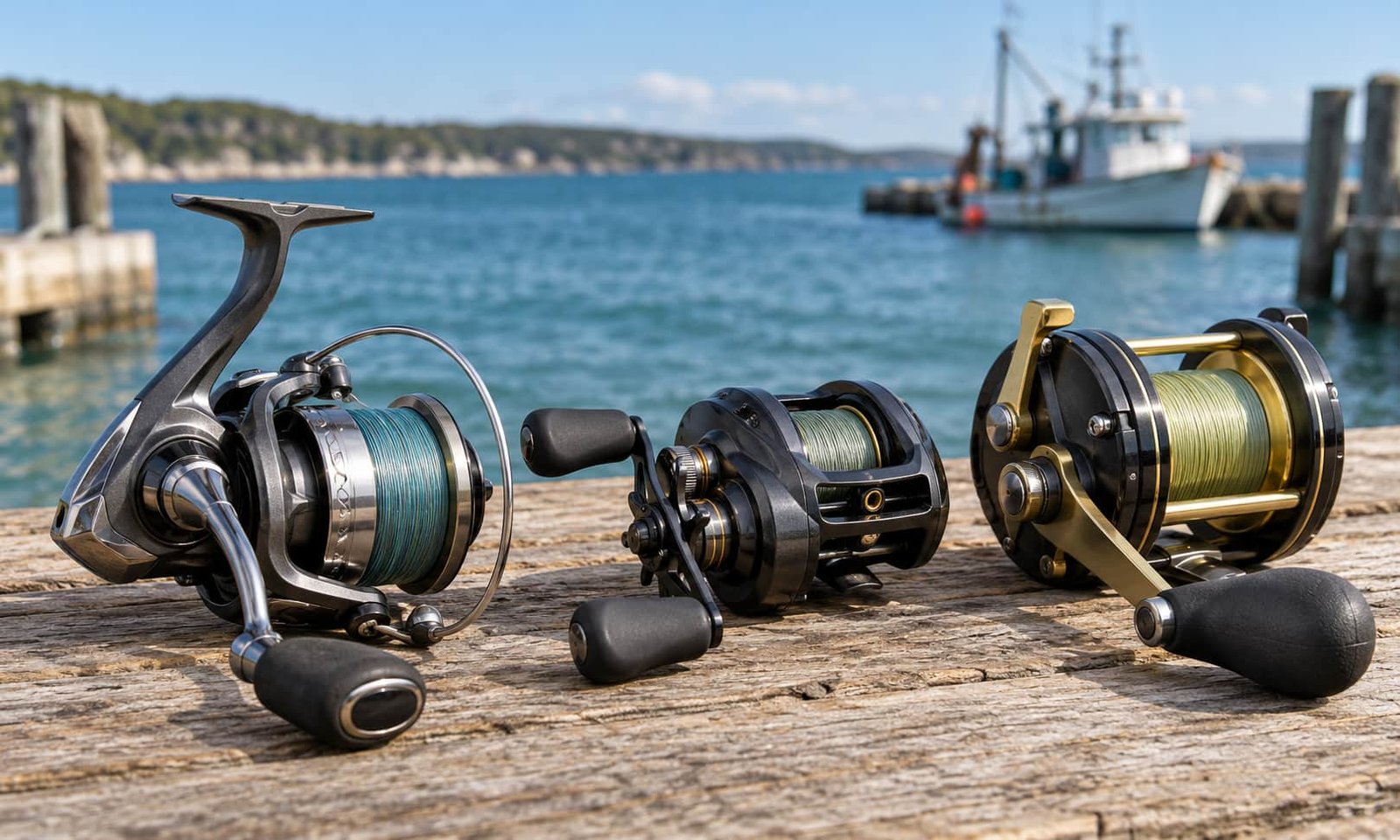
Learn how to choose a saltwater fishing reel for shore or boat fishing by comparing reel type, drag performance, and line capacity before you buy.
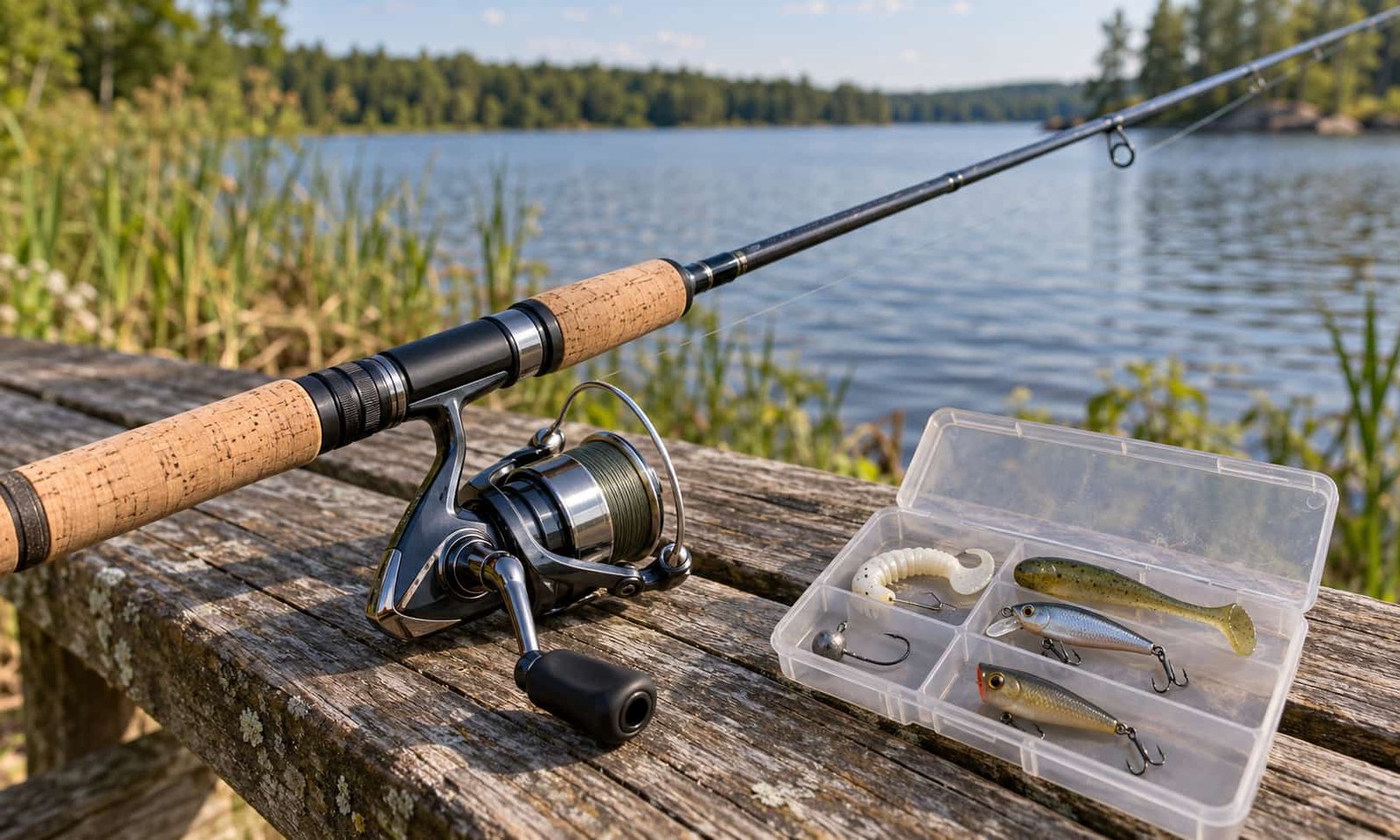
Build a bass fishing setup for beginners with a rod, braided line, and a leader that work together. Learn knots and casting before your first trip.
Learn how to adjust baitcaster brakes for better spool control, smoother casts, and fewer backlashes before you start pushing for more distance.
Not sure which rod to buy? Explore lure fishing gear for beginners, from rod length and power to reels, line, lures, and accessories.
Unsure what gear to buy first? This lure fishing setup for beginners guide covers spinning rods, reels, braid, fluorocarbon leaders, and lure weights.
Skip the crowded tackle bag. See which rod, reel, fishing line, and starter lures help you learn faster on the water.
Not sure which rig to tie on? See the difference between jig head and Ned hook before choosing your next soft bait setup.