How to Choose Jig Weight for 50 m and 100 m of Water
- Category
- Fishing lure
- Date
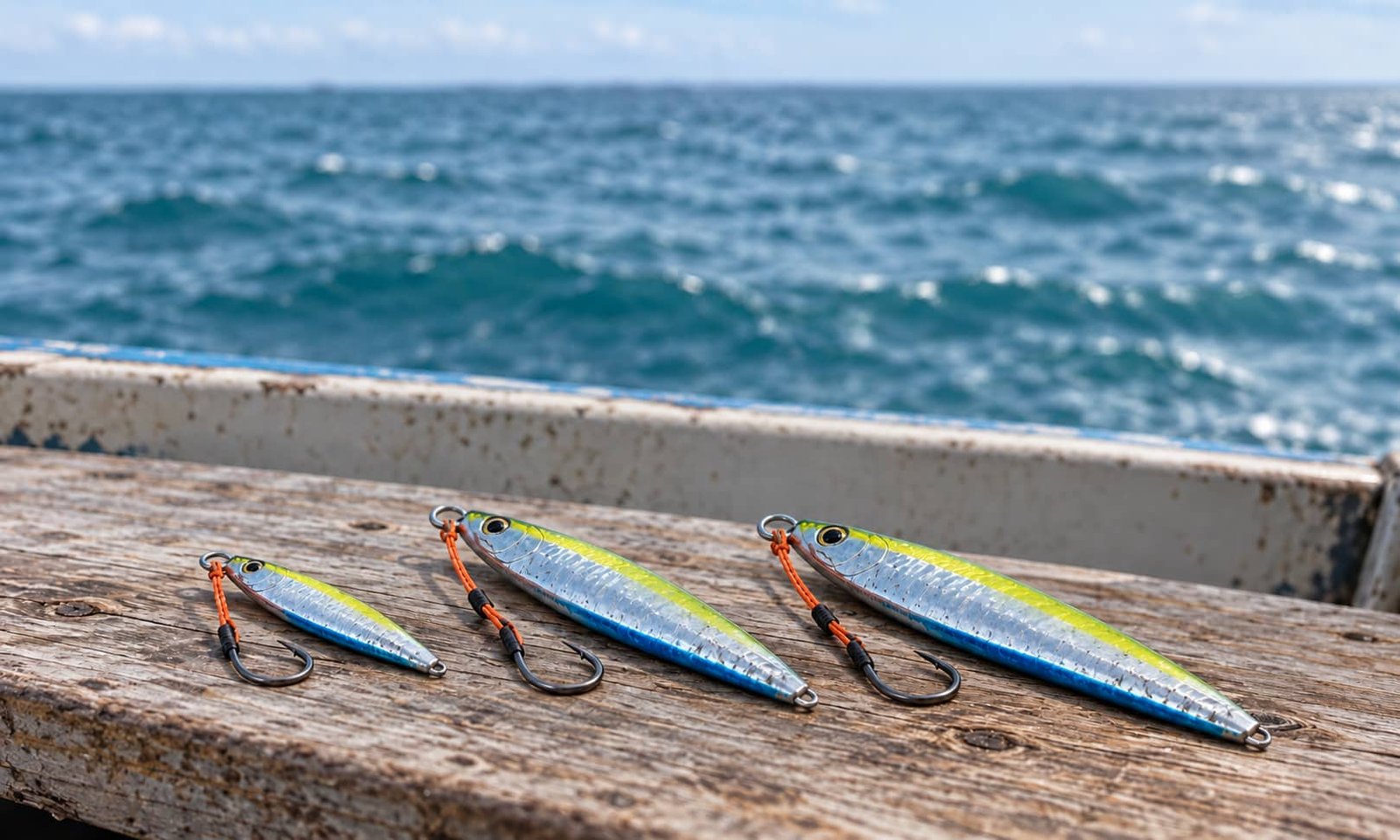
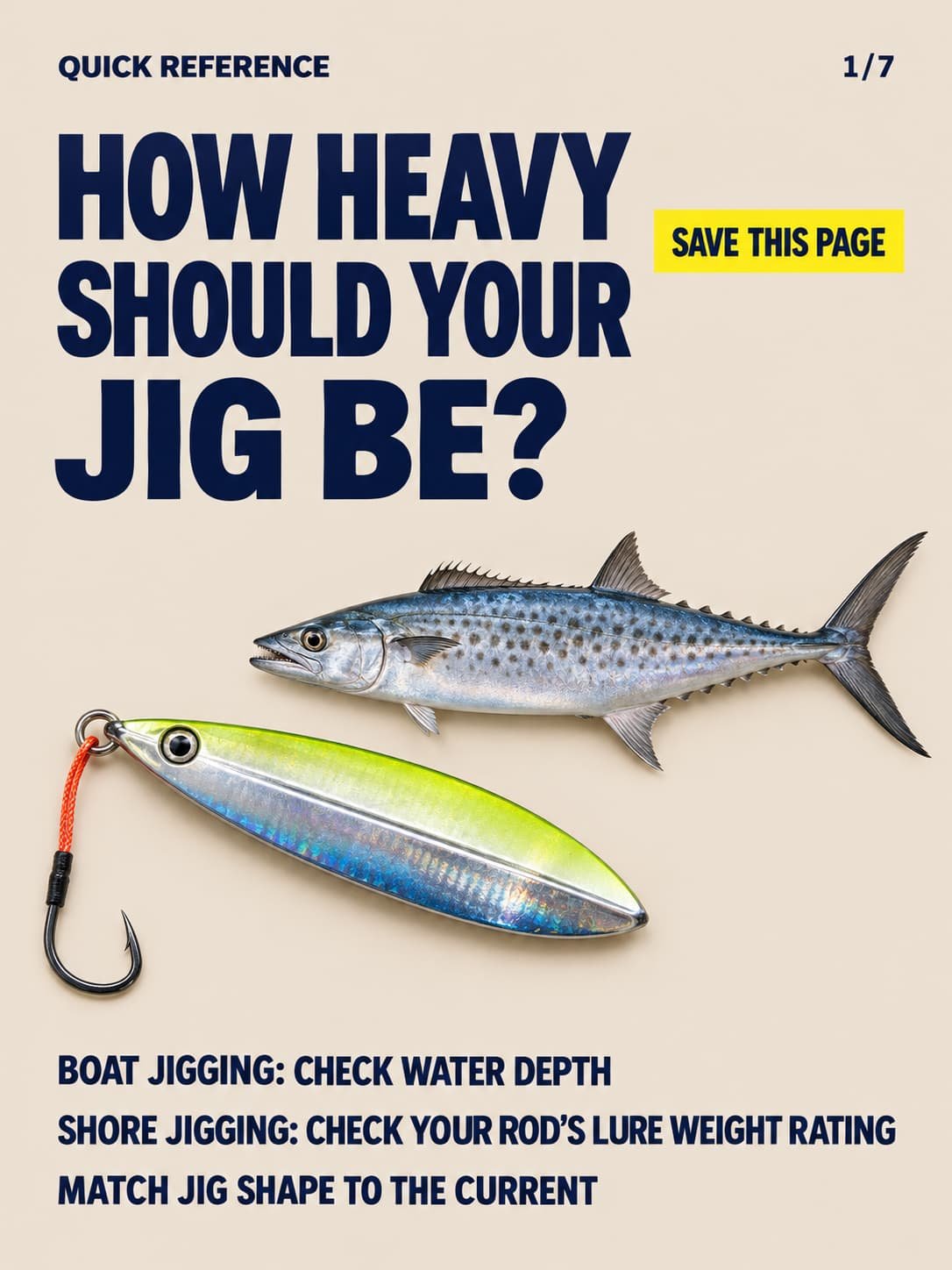
Choose a metal jig by the water depth, current, line diameter, and the weight your rod can handle. From a boat, the first question is whether the jig reaches the intended depth. From shore, the first check is the rod’s printed lure weight range. The same water depth can call for different weights with different jigging methods.
What determines the right metal jig weight?
The right metal jig weight lets you reach the fishing depth while keeping the tackle within the rod’s limits. A metal jig is a weighted metal lure that you cast or lower into the water, then work with the rod. Depth, current, line diameter, and jig shape all affect that choice.
What jig weight should you use from a boat?
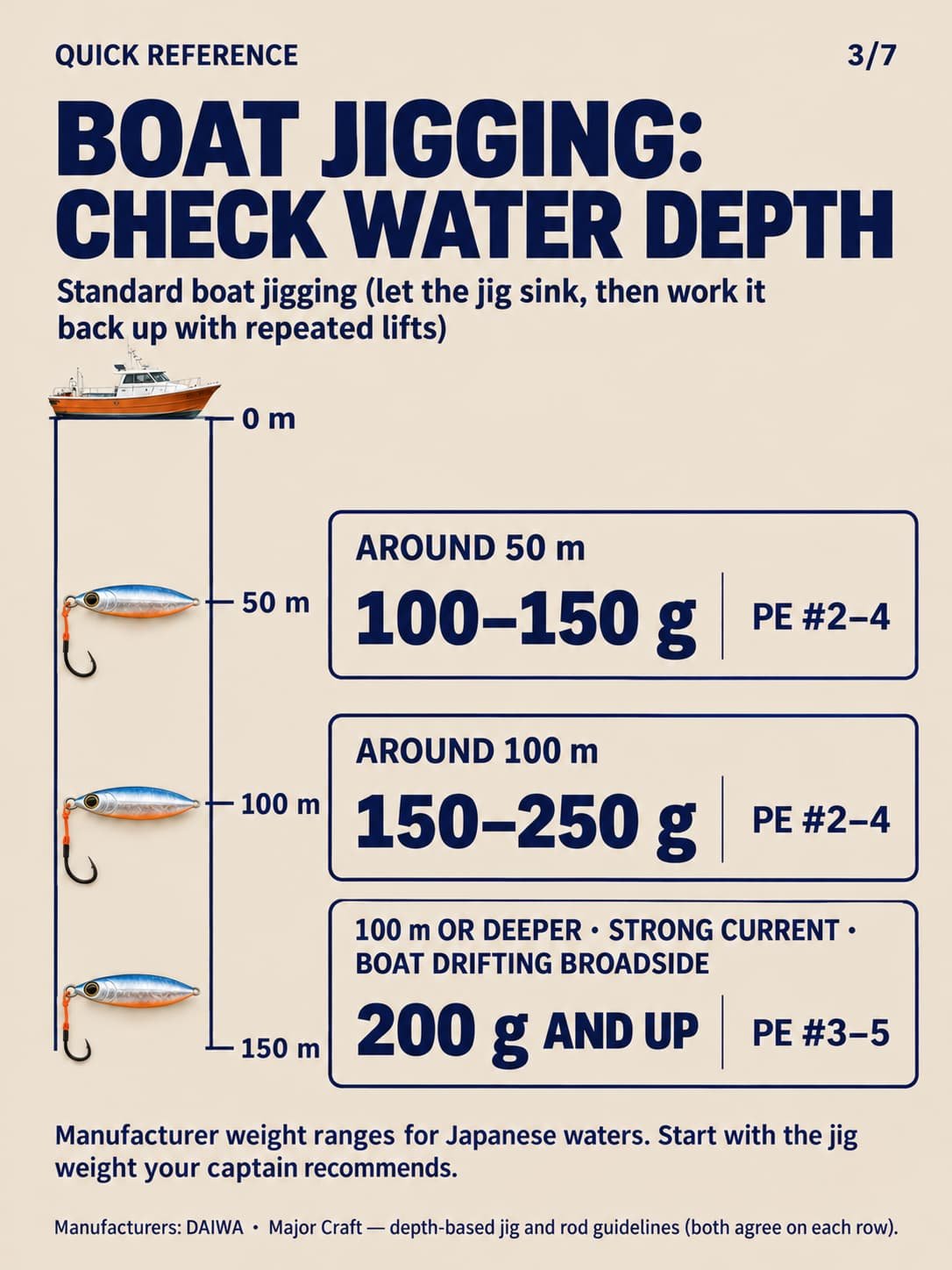
For standard boat jigging, start around 100–150 g in 50 m of water and 150–250 g around 100 m. Strong current or a boat drifting sideways (broadside) can call for more weight. At 100 m or deeper, those conditions may call for jigs of 200 g and up.
| Boat-jigging conditions | Jig weight | Braid size |
|---|---|---|
| Around 50 m deep | 100–150 g | PE #2–4 |
| Around 100 m deep | 150–250 g | PE #2–4 |
| 100 m or deeper, strong current or broadside drift | 200 g and up | PE #3–5 |
Treat the boat-jigging weights for Japanese waters as starting ranges. Try the jig weight your captain recommends for local conditions, and check whether the jig reaches bottom reliably.
Standard boat jigging means letting the jig sink, then working the lure back up with repeated rod lifts.
How useful is the depth-times-two rule?
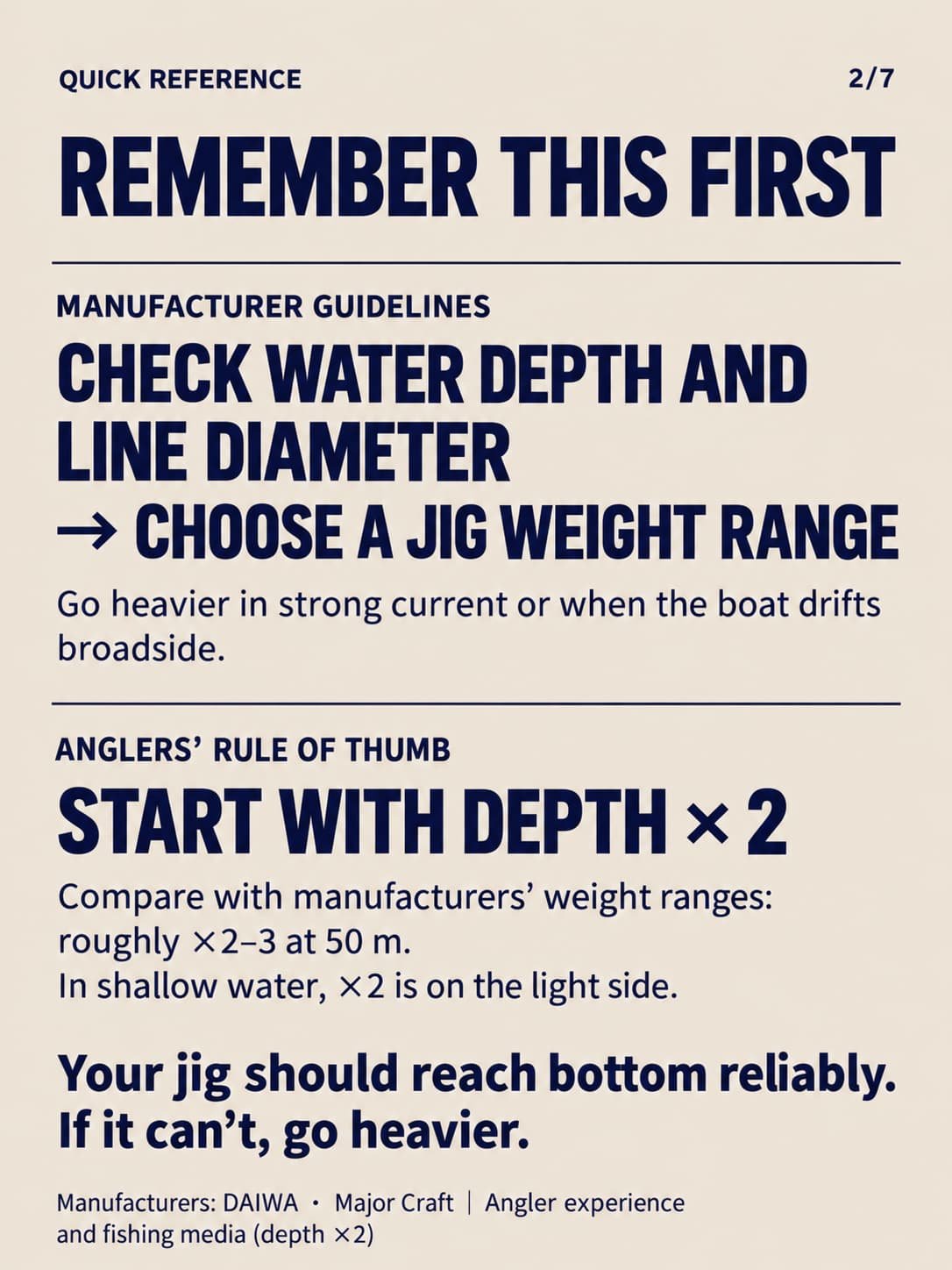
Multiplying water depth in meters by two gives a rough starting weight in grams for the standard boat-jigging approach. At 50 m, that calculation produces 100 g; the 100–150 g range corresponds to roughly two to three times the depth. Compare the shortcut with the actual conditions before settling on a weight.
The depth-times-two shortcut can be on the light side in shallower standard boat-jigging situations. Strong current and broadside drift still call for an adjustment. Use reliable bottom contact to judge the result rather than treating the calculation as a fixed requirement.
When does super light jigging make sense?
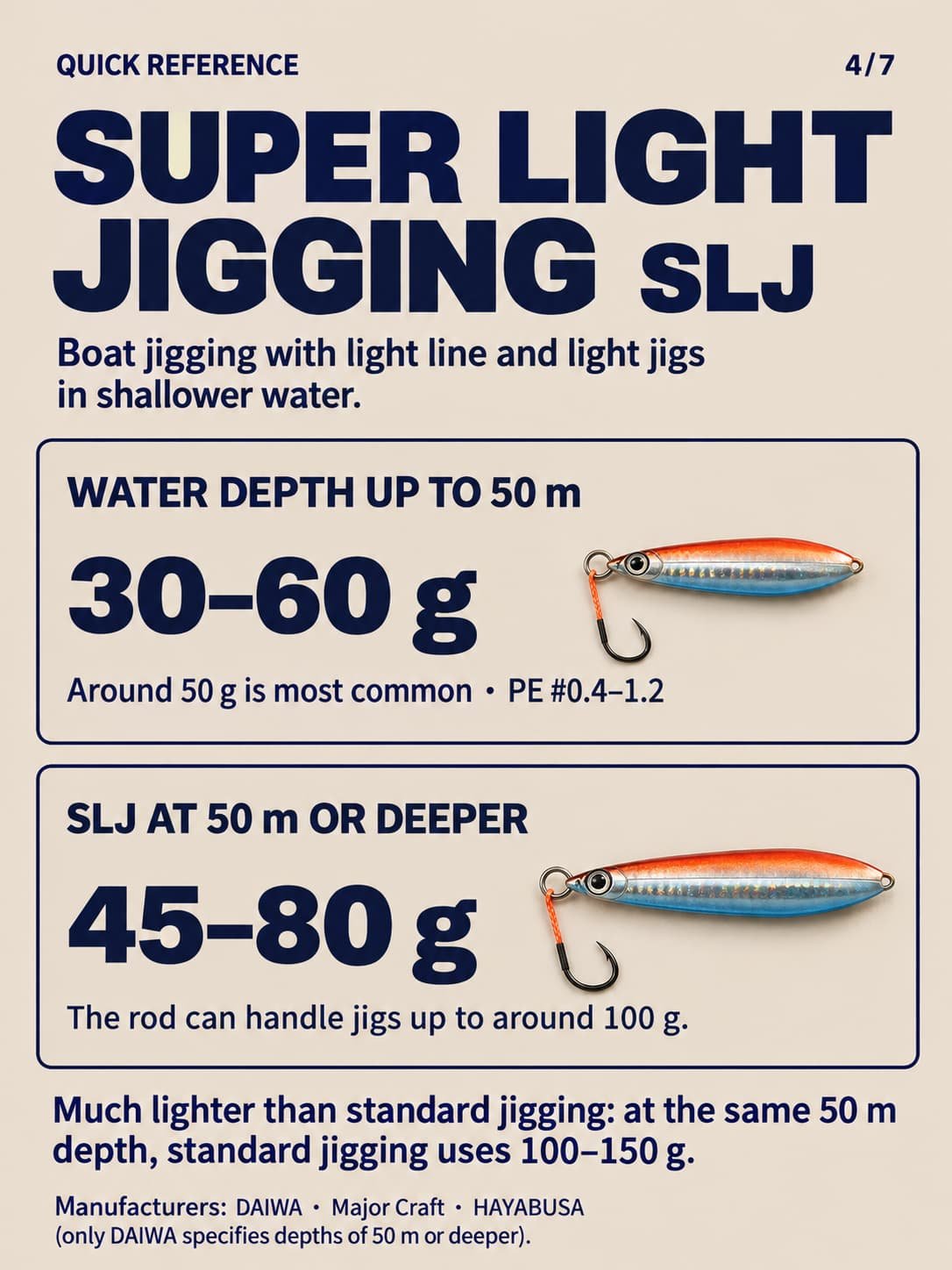
Super light jigging, or SLJ, uses light line and light metal jigs from a boat, particularly in shallower water. Up to 50 m, the weight range is 30–60 g, with around 50 g commonly used. The lighter tackle changes the weight selection compared with standard boat jigging at the same depth.
| SLJ conditions | Jig weight | Associated tackle detail |
|---|---|---|
| Water up to 50 m deep | 30–60 g | Around 50 g commonly used; PE #0.4–1.2 |
| SLJ at 50 m or deeper | 45–80 g | A rod capable of handling jigs up to around 100 g |
The deeper-water SLJ setup uses a rod capable of handling jigs up to around 100 g.
At 50 m, the SLJ range is 30–60 g, while the standard boat-jigging range is 100–150 g. Let the jigging method and matched tackle determine which range you use at that depth.
What jig weight should you cast from shore?
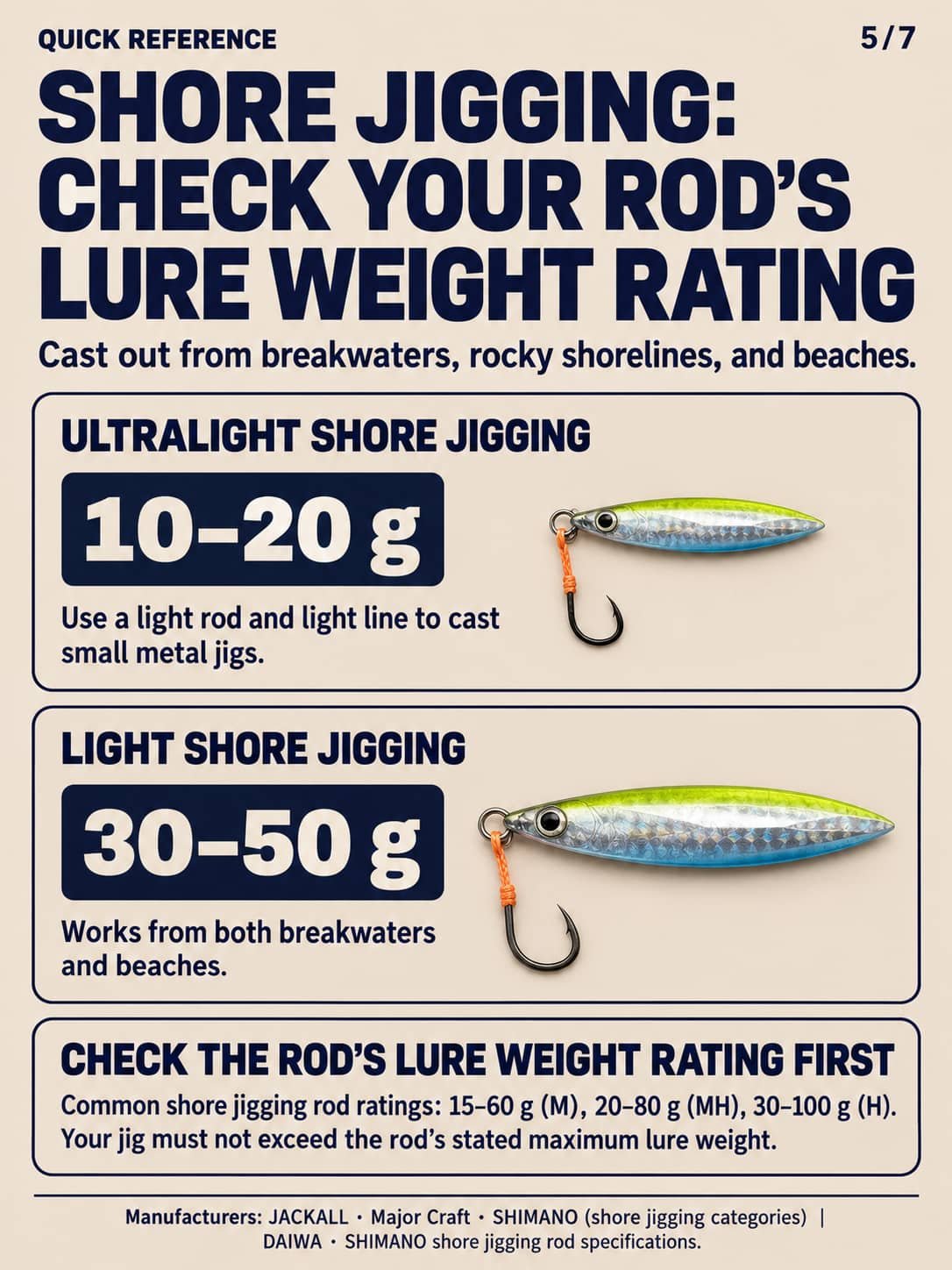
For shore jigging, the ultralight weight range is 10–20 g and the light range is 30–50 g. Cast these metal jigs from suitable breakwaters, rocky shorelines, or beaches. Check the rod’s lure weight rating before choosing a jig, because the lure must stay within the weight the rod is designed to cast.
| Shore-jigging approach | Jig weight | Application |
|---|---|---|
| Ultralight shore jigging | 10–20 g | A light rod and light line for casting small metal jigs |
| Light shore jigging | 30–50 g | Useful from breakwaters and beaches |
How do you read a rod’s lure weight rating?
A shore rod’s lure weight rating, also called its casting weight range, tells you which lure weights the rod is intended to cast. Read the gram range on the rod before choosing a jig, and keep the jig within that rod’s printed maximum.
| Rod power label | Meaning | Example lure weight range |
|---|---|---|
| M | Medium | 15–60 g |
| MH | Medium-heavy | 20–80 g |
| H | Heavy | 30–100 g |
For a shore rod marked 15–60 g, a 50 g jig falls within the printed range. A 100 g jig exceeds that rod’s 60 g maximum. Check the range on the actual rod, since a power label alone does not replace the printed lure weight specification.
How does jig shape affect the fall?
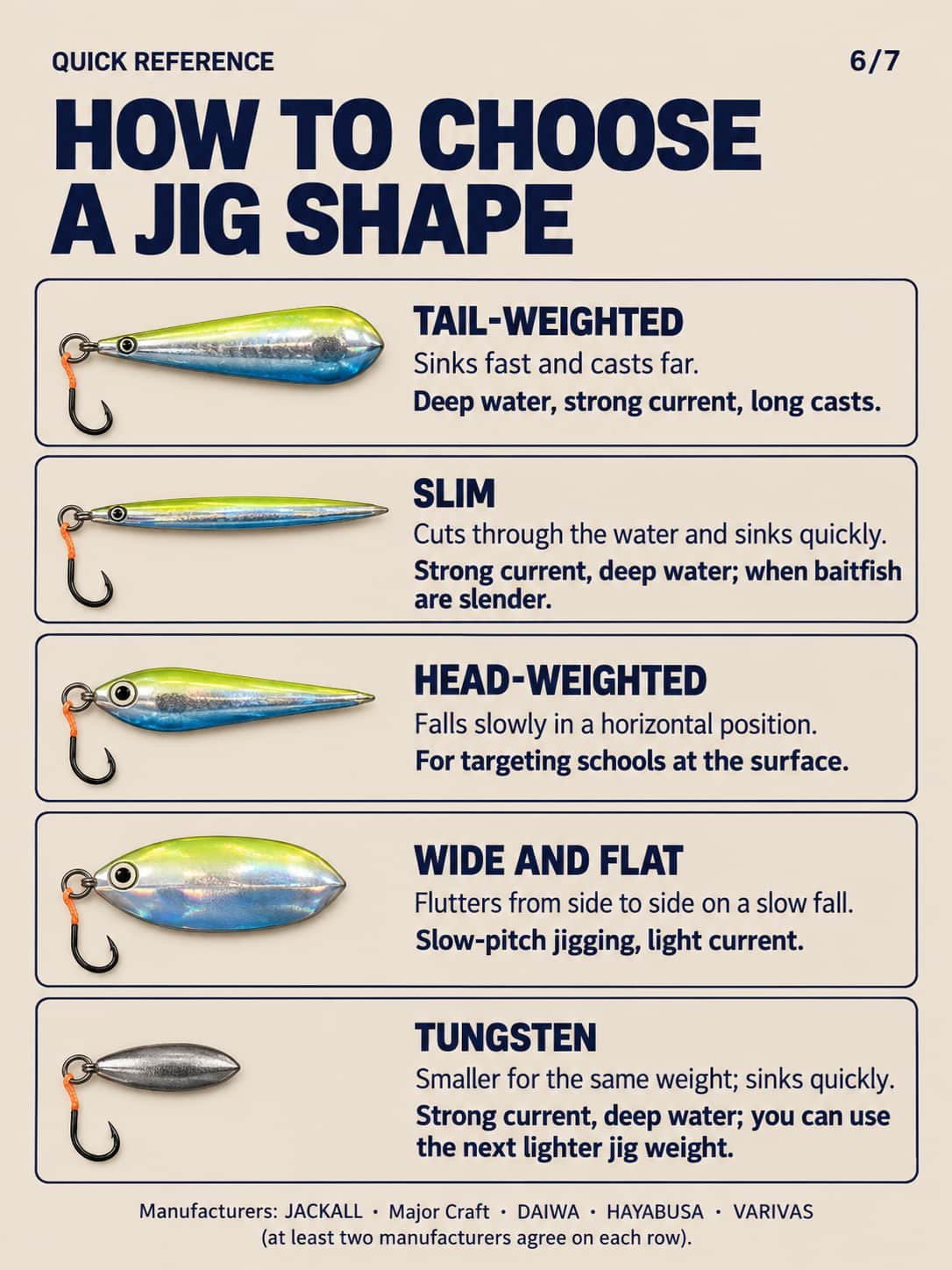
Jig shape and weight balance affect how the lure moves through the water. Slim profiles sink quickly, while broad, flat profiles produce a slower, side-to-side fall. Tail weighting helps with fast sinking and longer casts. Choose the profile around the current, required depth, and the type of fall you want to use.
| Jig profile or material | Action described | Conditions or use |
|---|---|---|
| Tail-weighted | Sinks fast and casts far | Deep water, strong current, long casts |
| Slim | Cuts through the water and sinks quickly | Strong current, deep water, slender baitfish |
| Head-weighted, slow-fall profile | Falls slowly while remaining horizontal | Targeting schools at the surface |
| Wide and flat | Flutters from side to side on a slow fall | Slow-pitch jigging and light current |
| Tungsten | A smaller body at the same weight; sinks quickly | Strong current and deep water; the next lighter jig weight may work |
Weight balance describes where a jig carries more of its weight, toward the head or toward the tail.
A head-weighted, slow-fall profile suits surface-school fishing when the jig falls slowly in a horizontal position. Match the stated action to the individual model when choosing that profile.
Slow-pitch jigging makes use of a wide, flat jig’s slow, side-to-side fall.
Tungsten provides a compact body for the same weight. In strong current or deep water, a tungsten jig may let you use the next lighter jig weight.
What should you change if the jig cannot reach bottom?
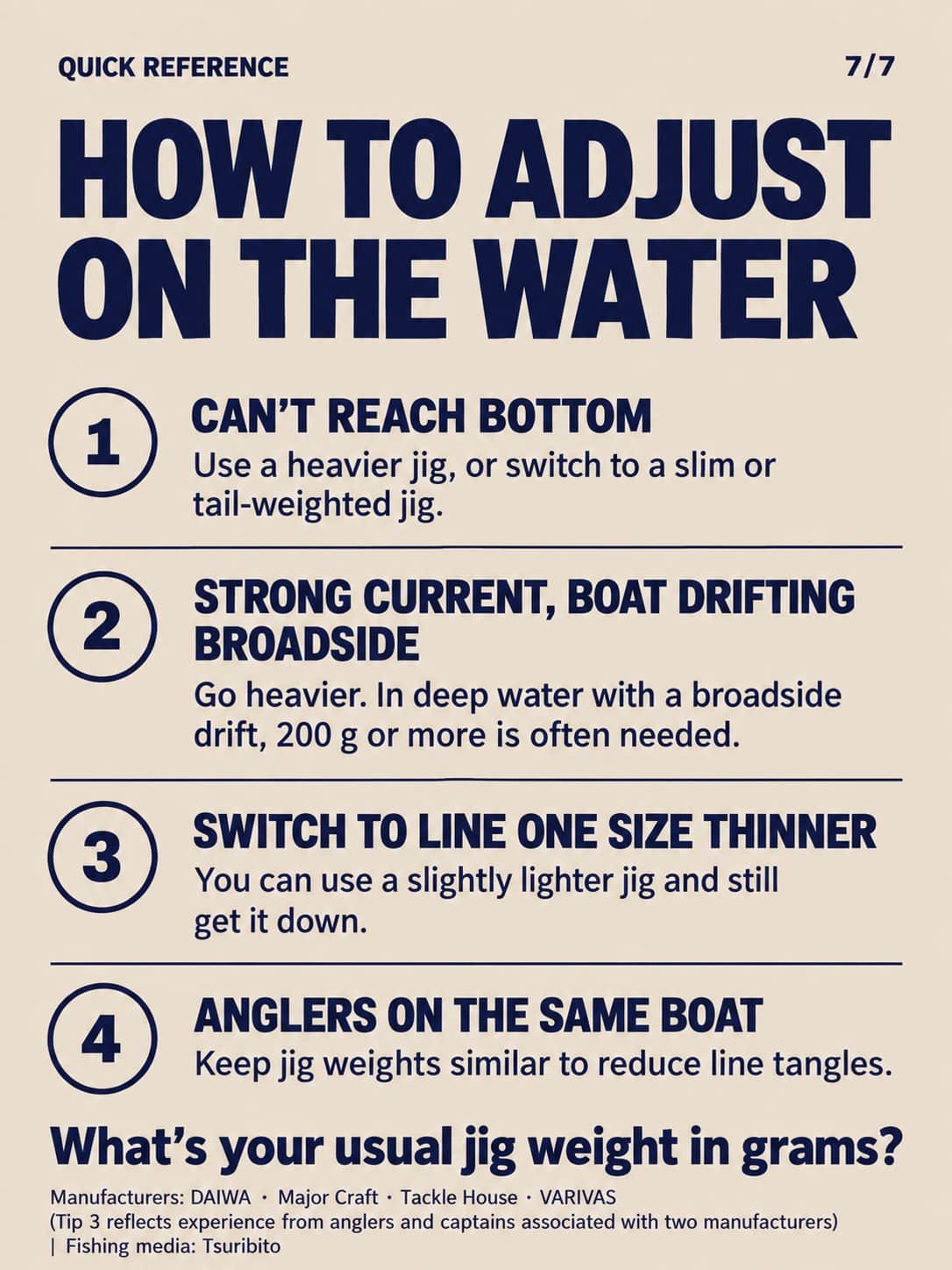
Increase jig weight, or try a slim or tail-weighted jig, when the current prevents the existing lure from reaching bottom. Strong current and a boat drifting broadside both push the choice toward more weight. In deep water, that sideways drift often calls for a jig of 200 g or more.
How does thinner line change jig selection?
Switching to line one size thinner can let you use a slightly lighter jig and still get the lure down. Line diameter therefore belongs in the same decision as jig weight and profile. Treat the change as one step down from the line already on your reel.
For braided fishing line, PE numbers identify the line-size designation. PE #0.4–1.2, PE #2–4, and PE #3–5 describe braid sizes, not pound-test values. Keep those line-size designations separate from jig weights given in grams.
Why should anglers on the same boat use similar jig weights?
Anglers on the same boat should keep their jig weights reasonably similar to reduce line tangles. Compare the weights being used alongside you when deciding whether to change jigs. Keep enough weight to reach the required depth, while choosing a similar range to the other anglers aboard.
More to Explore
Related Articles
More guides in Fishing lure
Favorite lure color not getting bites? Learn how to choose lure colors for water clarity, light, and fish activity, from bright soft plastics to natural baitfish patterns.
Compare the best lures for trophy fish in plain English. See how six options move, where they work best, and which ones fit your next trip.
Learn how to fish a popper lure, from picking a weight for shallow or open water to working the surface with short twitches and pauses.
Hard baits vs soft baits explained through four fishing situations. See what to cast in open water, heavy cover, or murky water.
Learn how to choose flies for fly fishing by reading the water, matching the hatch, and picking the right fly size and color for each situation.
Learn how to choose micro spoons by shape, depth, and current so you can match your lure to the water before your first cast.
See how the best micro fishing lures compare, from versatile metal jigs to more technical options that take a little practice. Learn where each lure fits best and choose your next one with more confidence.
Not sure which lure to start with? This guide breaks down the best fishing lures for beginners and explains four simple, proven options that are easy to learn and worth keeping in your tackle box.